Can 14 Percent Happen Twice? Shettigere's Proof Calendar
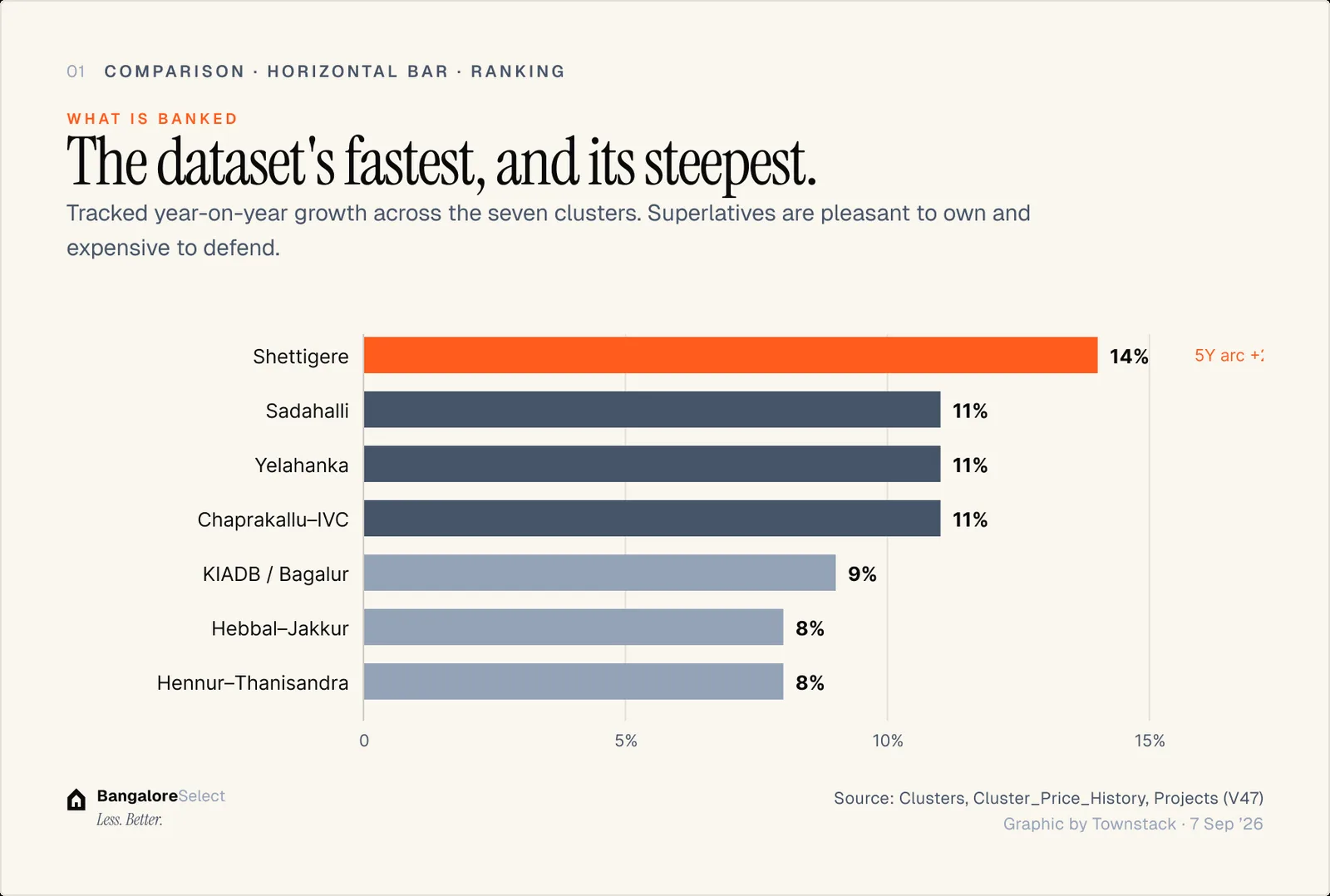
Shettigere enters the window holding the tracked dataset's two superlatives: the fastest year-on-year appreciation, at 14 percent, and the steepest five-year arc, at 225 percent. Superlatives are pleasant to own and expensive to defend. The next eighteen months are the defence.
Shettigere enters the window holding the tracked dataset's two superlatives: the fastest year-on-year appreciation, at 14 percent, and the steepest five-year arc, at 225 percent. Superlatives are pleasant to own and expensive to defend. The next eighteen months are the defence.
The cluster earned its rate the honest way: direct frontage on the airport metro's first leg, the corridor's strongest demand-and-liquidity pairing at 90 and 87, and a supply book kept unusually thin at 1,133 tracked units. But a 14 percent rate is a promise about the future made at compound interest, and the future now has specific dates on which it must deliver.
And this year the calendar gained its largest entry yet: BIAL's Airport City, an entire adjacent economy under construction one metro stop away. Here is the calendar on which north Bangalore's fastest cluster proves it wasn't just early: it was right.
What's already banked
The hardware around Shettigere has mostly stopped being hypothetical. Terminal 2's ₹17,000 crore expansion is funded and building toward 85 million passengers. Birla Trimaya and Tata Varnam are selling: ₹1.35 to ₹4.9 crore: into demand the indices confirm. The international-school belt sits one corridor west on IVC Road. Stonehill and Harrow, a ten-to-fifteen-minute catchment rather than a local possession. And the thin supply book is itself banked evidence: this cluster's owners chose scarcity when every neighbouring cluster chose scale, and the 14 percent is partly that choice paying out.
Watch: Airport City rises next door
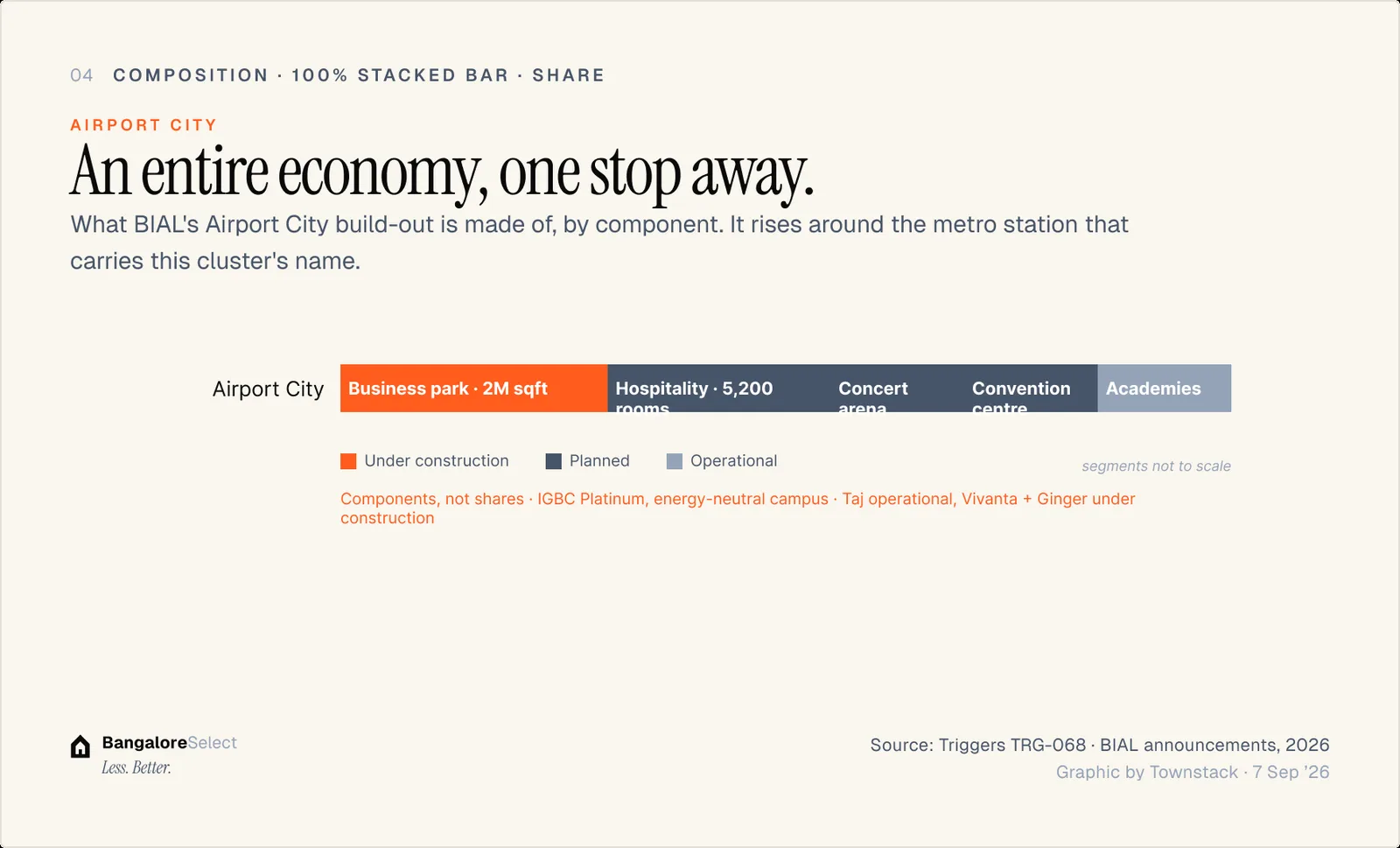
The biggest item on Shettigere's calendar isn't the metro: it's the city being built at the end of it. BIAL's Airport City, wrapped around the Airport City metro station one stop from this cluster's frontage, has moved from masterplan to construction: a two-million-square-foot flagship business park in four biophilic blocks is now under build, alongside India's first in-airport concert arena, a convention and exhibition centre, and a 775-key Vivanta-and-Ginger combo hotel, with 5,200 hotel rooms planned campus-wide and the Taj already operational.
This is the aerotropolis thesis acquiring hardware, and Shettigere is its residential doorstep. Watch the business park's structural progress and the first anchor-tenant announcements: an office population at Airport City is demand that never touches NH-44, and an arena-and-hotel district is the kind of amenity gravity that usually takes a corridor a decade to assemble. No other watch item in this series adds a whole adjacent economy.
Watch (late 2026): the airport clears its throat
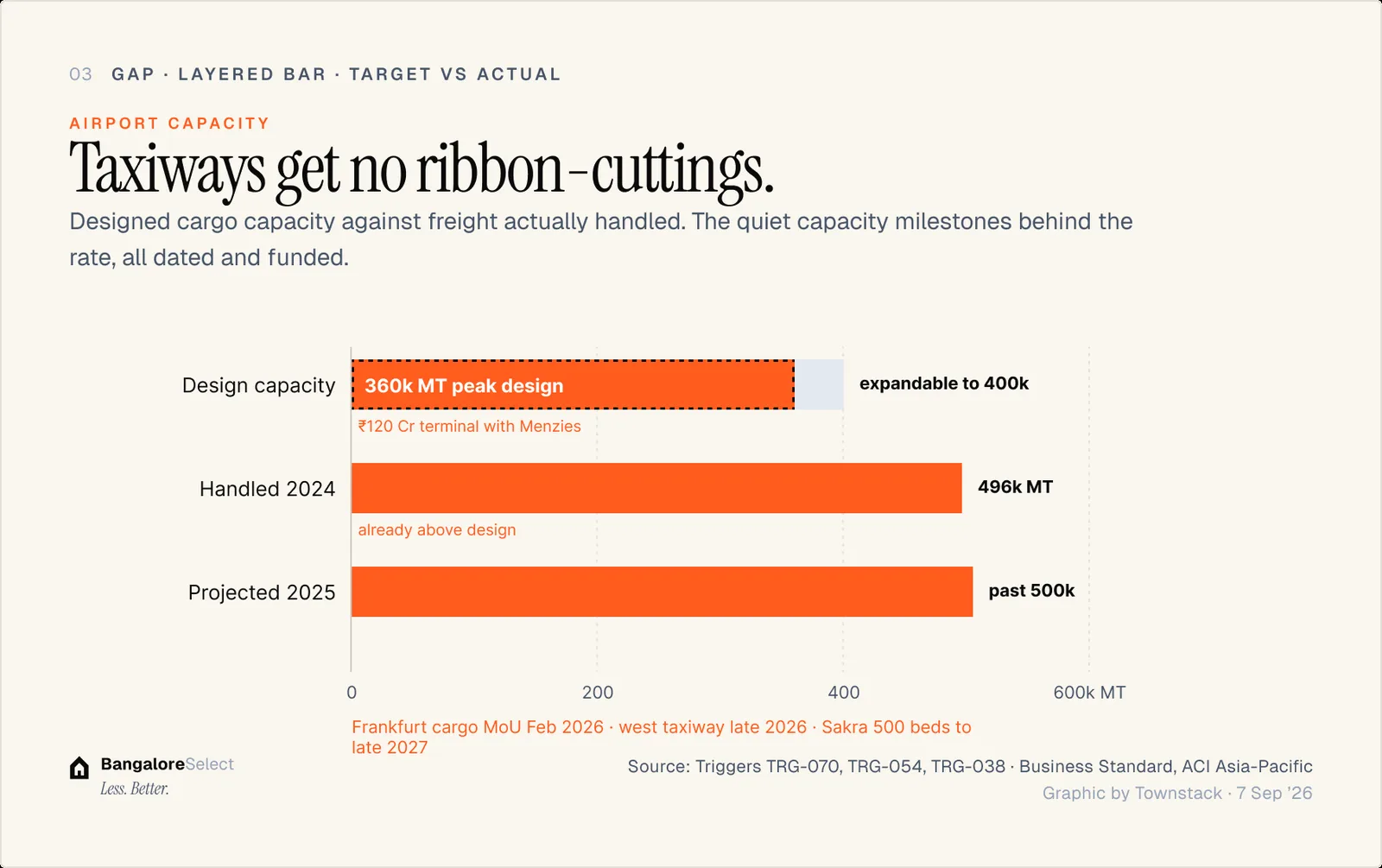
Quieter but dated: BIAL's west cross-field taxiway, commissioning late 2026. It reads like operational trivia (taxiways don't get ribbon-cuttings) but it is a concrete airport-capacity milestone inside the window, and Shettigere's economy is airport throughput at one remove. The cargo side is compounding too: the ₹120 crore Menzies-operated domestic terminal opened with 360,000-tonne peak capacity, and the Frankfurt Airport MoU formalised international cargo cooperation: handling and cold-chain payroll that lands on this side of the campus. Watch alongside these for Sakra World Hospital's second campus: 500 beds, ₹1,000 crore, a 30-month build targeting late 2027.
Watch (June 2027): the leg itself
The airport-side first leg (June 2027 service, reaffirmed at the June 2026 review) is the date the entire 14 percent leans on. The staging tells arrive earlier: trial runs beginning off the delivered trainset, station fit-out at the cluster's frontage, safety-commissioner inspections in the spring. Each one that lands on time is a quarter of appreciation defended.
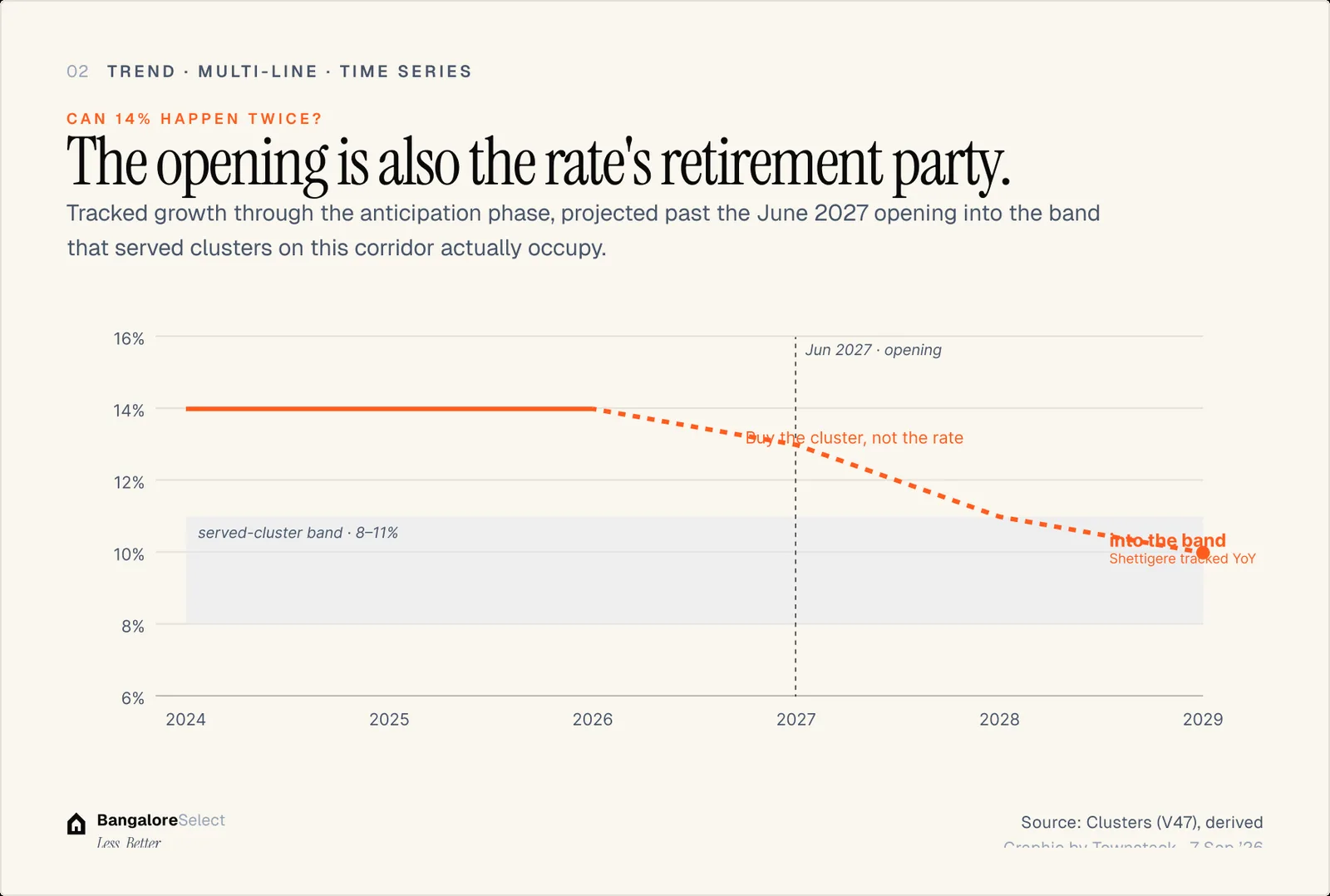
Then comes the part nobody prices: the day after. When the leg opens, Shettigere stops being a metro-anticipation trade and becomes a metro-served cluster: a different asset class with a different growth rate. The 14 percent was the anticipation premium compounding. Post-opening, the honest comparators are served clusters growing at 8 to 11. The opening is simultaneously the thesis's triumph and the rate's retirement party.
The calendar at a glance
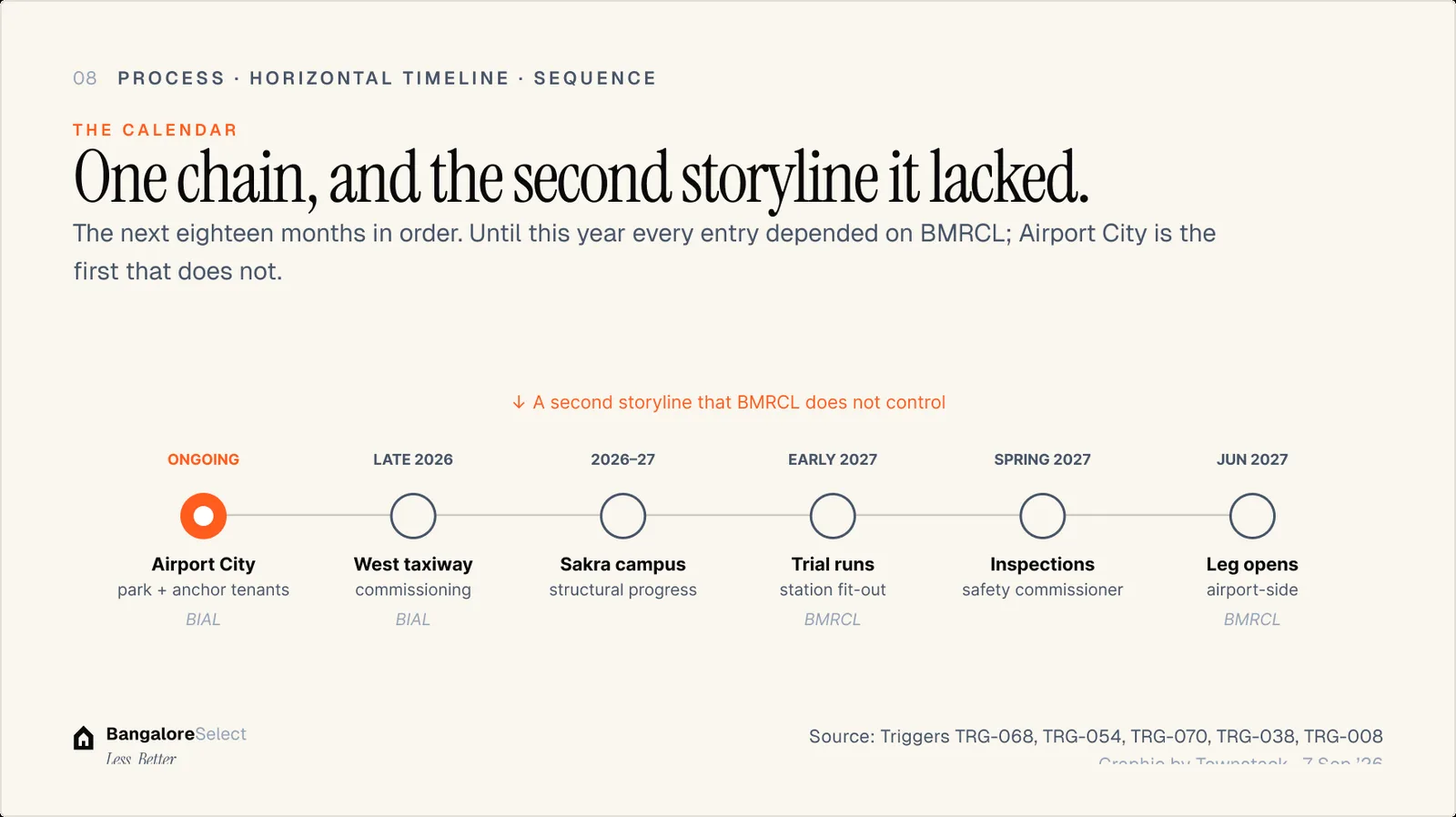
Ongoing: Airport City's business park under construction around the cluster's namesake station: structural progress and anchor tenants are the tells. Late 2026: BIAL's west cross-field taxiway commissions: quiet, dated, and the first checkpoint on the airport-capacity story. Through 2026-27: Sakra second campus structural progress toward its late-2027, 500-bed opening. Early 2027: trial runs through the cluster's frontage; station fit-out visible from the road. Spring 2027: safety-commissioner inspections, the last administrative gate. June 2027: the airport-side leg opens, and Shettigere converts from anticipation trade to served cluster.
Until this year the calendar was a single dependency chain ending at the metro. Airport City is the second storyline it lacked: an adjacent economy that builds whether or not the trains run on time. That is a structural upgrade to the cluster's risk profile, not just another entry.
The risk column
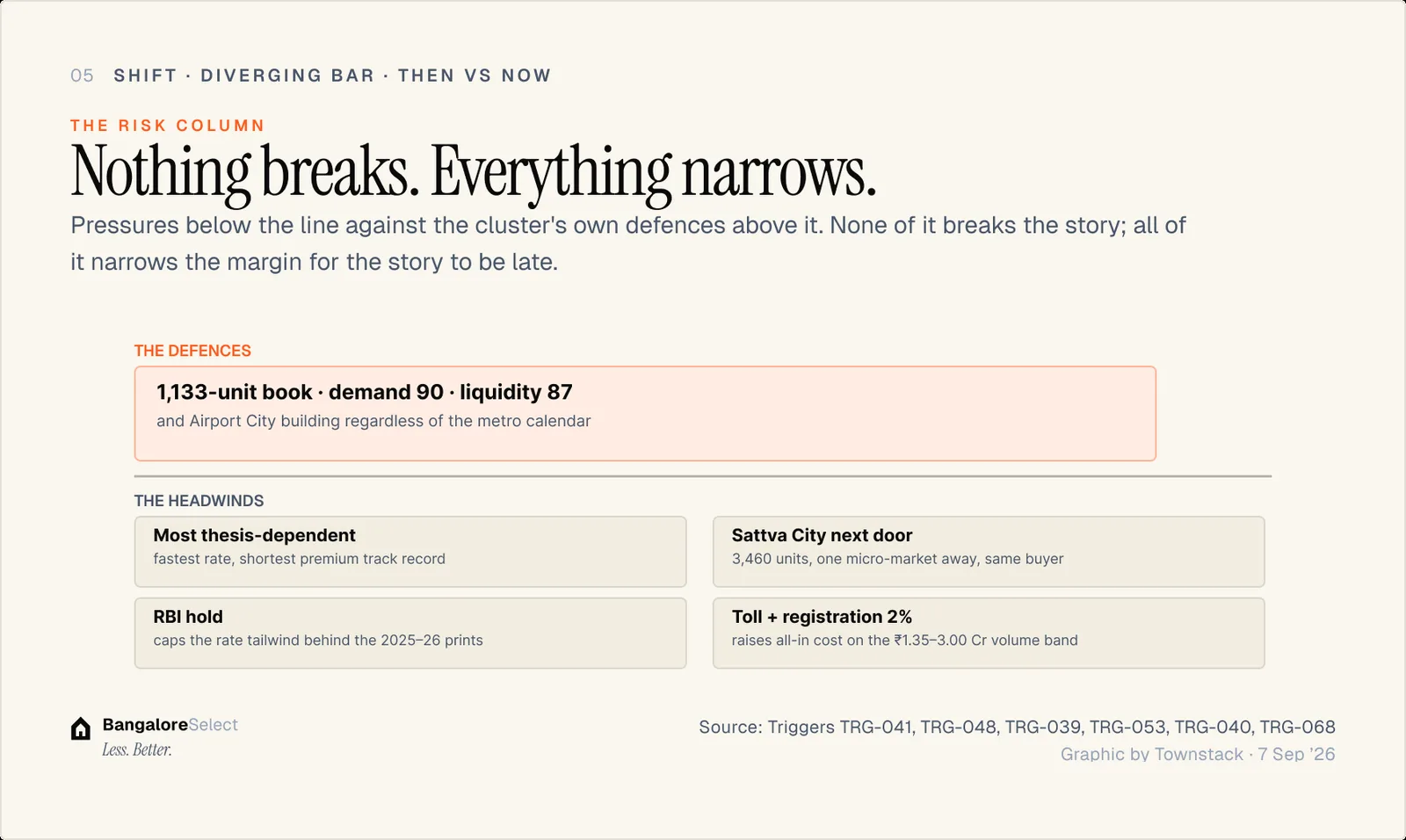
The rate itself is the headline risk: fastest-appreciating means most-thesis-dependent, and Shettigere has the shortest track record of the premium claimants. A metro slip past mid-2027 still hits this cluster hard, though less nakedly than a year ago, now that Airport City's build-out gives the thesis a second leg that doesn't depend on BMRCL's calendar.
The corridor risks apply with local twists. The 37,103-unit supply wave mostly breaks on neighbouring clusters, but Sattva City's 3,460 units sit one micro-market away and compete directly for the same airport-economy buyer. The June 2026 MPC's neutral-to-hawkish hold caps the rate tailwind that flattered every 2025-26 print. And the April 2026 toll hike plus the 2 percent registration fee raise the all-in cost of exactly the ₹1.5-to-3 crore purchase this cluster's volume runs on. None of it breaks the story. All of it narrows the margin for the story to be late.
What you'll know by mid-2027
By next summer the question in this post's title answers itself. Trains running through Shettigere in June, Airport City's business park topping out with tenants named, taxiway commissioned, Sakra on schedule: the 14 percent will have converted into the corridor's cleanest realised thesis, and the cluster's next chapter (slower, served, sturdier) begins from a higher floor. That is the good outcome, and it includes the rate coming down.
A slipped leg and a quiet taxiway, and Shettigere spends 2027 as a fast rate with nothing new underneath it, which is how fast rates end badly. The desk's read: the first outcome is more likely, but buy the cluster, not the rate. The rate was never going to happen twice. The cluster might.
Sources. BangaloreSelect Tracked Dataset (BS_AutoResearch V44, Jul W3 working file). Airport-side leg June 2027 and trainset status: BMRCL ministerial review, June 19, 2026. West cross-field taxiway: BIAL project reporting. Sakra second campus: company announcement, May 2025. Rate stance: RBI MPC, June 2026. Supply print: ANAROCK Q2 2026. BIAL Airport City (2M sqft business park, concert arena, 775-key hotel): BIAL announcements, 2026. KIA cargo terminal (₹120 Cr, Menzies) and Frankfurt MoU: Business Standard / ACI Asia-Pacific.
Read more on the Shettigere Cluster cluster page for the live project list, trigger feed and price-history chart referenced in this article.
Want our next North Bangalore report in your Google results? Add BangaloreSelect as a preferred source and new reports show up in your Top Stories.