The Premium That Doesn't Need the Metro: Why Hebbal-Jakkur Trades at ₹18,000 PSF on What's Already Built
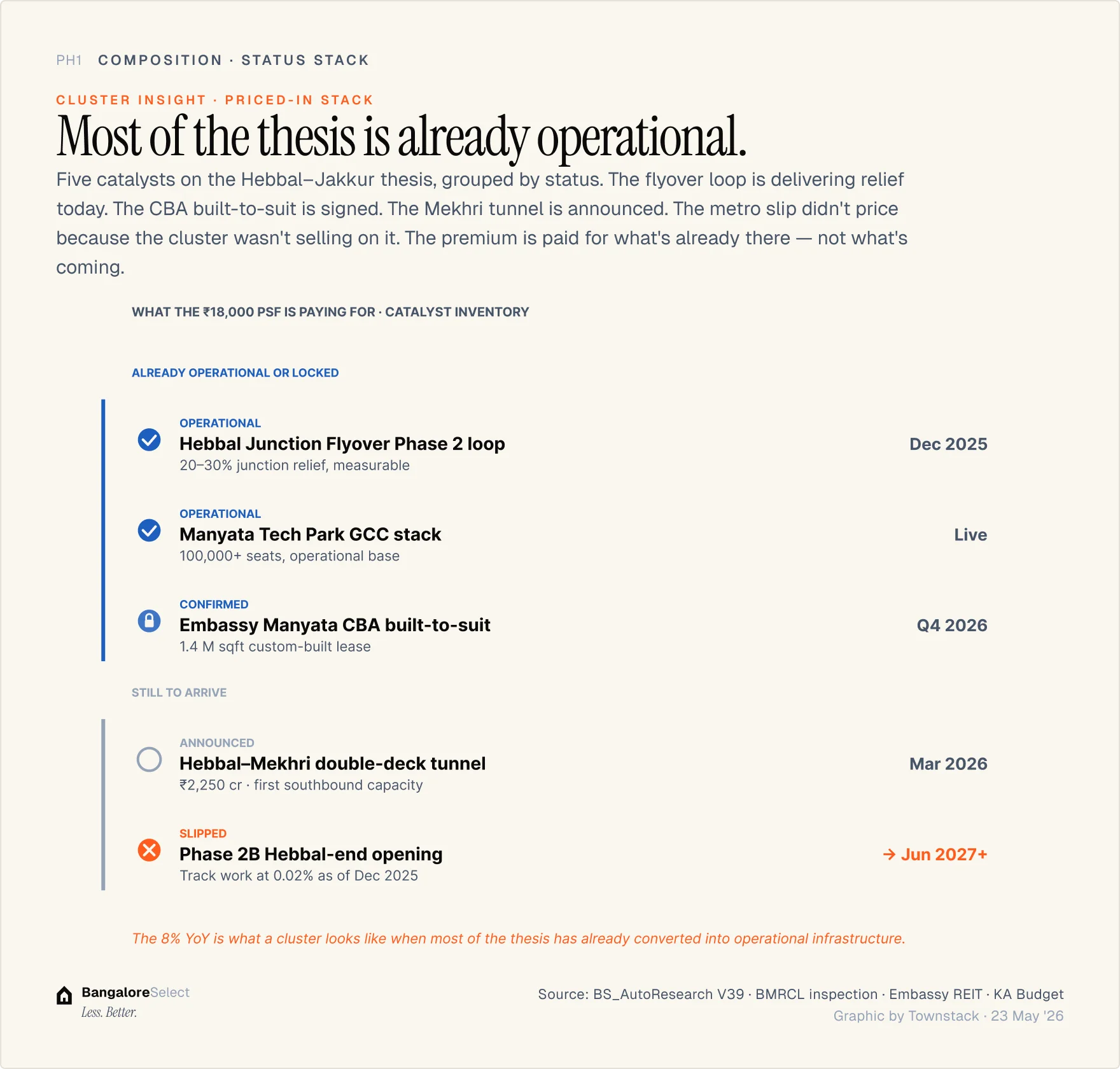
Hebbal-Jakkur prices its premium on infrastructure that is already operational, Hebbal Junction Phase 2 flyover loop, Manyata Tech Park (anchored by Commonwealth Bank built-to-suit), and confirmed Phase 2B metro arrival, rather than on catalysts still to come. At ₹18,000 psf the 8% YoY appreciation reflects absorption of an already-arrived thesis.
Stand at Hebbal Junction on a weekday at 8 PM. The flyover above you is carrying northbound traffic, toward Devanahalli, toward the airport, toward the Manyata GCC stack, at something close to a normal speed. The traffic heading south, into the city, isn't moving at the same speed. It hasn't for some time.
That isn't a temporary peak-hour reading. It's a slow, structural drift in Bangalore's centre of economic gravity, and the cluster sitting at the top of the flyover, Hebbal-Jakkur, is the one most fully priced against that drift. ₹18,000 a square foot is the headline number. The 8 percent year-on-year appreciation is what the market reads as fair for a cluster where most of the thesis has already converted into operational infrastructure.
What Hebbal-Jakkur is selling at this PSF isn't catalyst arrival. It's catalyst absorption.
The eight percent that's already happened
Hebbal-Jakkur trades at the airport corridor's premium but appreciates slower than Shettigere (14%) and Sadahalli (11%). That's not a sign of weakness. It's what appreciation looks like when most of what could go right has already gone right. The Hebbal Junction Flyover Phase 2 loop opened December 2025 and is already delivering 20 to 30 percent junction relief, measurable today, not promised for 2027. Manyata Tech Park's 100,000-plus seat-count GCC base is operational. Embassy's Phase 2A million-sqft expansion at Nagawara is under construction with confirmed tenant intent. Access to the Outer Ring Road is, by Bangalore standards, predictable.
The cluster's Demand Index sits at 90 out of 100. Liveability at 90. Liquidity at 87. These aren't the numbers a corridor produces when its thesis is on the come.
Manyata, the named tenant
There's a specific moment that anchors the Hebbal premium. In late 2025, Embassy filed disclosure on a built-to-suit lease of 1.4 million square feet to Commonwealth Bank of Australia at Embassy Manyata, with Q4 2026 occupancy. A built-to-suit is the strongest possible commercial-real-estate signal, a tenant commits to a custom-designed building before it's built. CBA isn't shopping the Bangalore market. CBA is the Bangalore market.
The Manyata story, until that point, was a depth question. There were 100,000 seats, but how many were leased to anchor tenants versus rotational consulting firms versus sub-leased subsidiary entities of larger GCCs? CBA names a specific principal. The premise that Hebbal-Jakkur's residential demand is anchored on Manyata's office demand needs an anchor tenant that can't be sub-leased away. It now has one.
The slip that didn't price
The Phase 2B Reach 2B Package 1 inspection in December 2025 found Hebbal-end track work at 0.02 percent completion, a number that sits firmly in the 'someone counted carefully' category. The Hebbal-end opening has subsequently slipped to June 2027 or later. In a cluster that was selling on metro proximity, this should have shown up as price softness.
It didn't.
That non-outcome is the cluster's tell. Hebbal-Jakkur's ₹18,000 isn't paid for metro arrival timing. It's paid for the infrastructure that's already operational and the office tenant base that keeps getting deeper. The metro slip is upside compressed, not downside materialised. If the metro arrives in mid-2027, Hebbal reprices upward. If it slips further, the floor still holds. That's the structural difference between a cluster priced on what's done and one priced on what's coming.
Two projects, one supply window
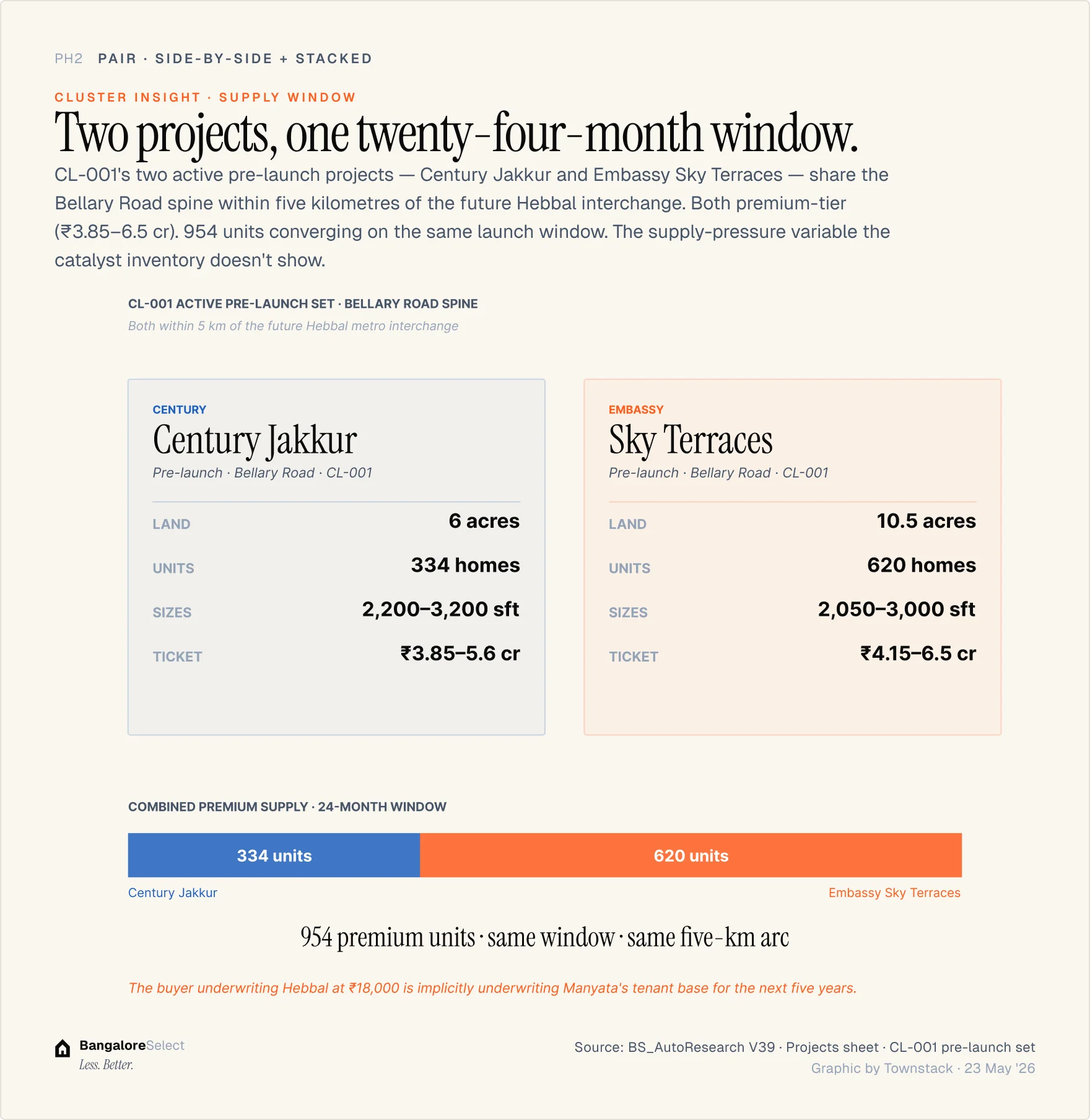
The cluster has two active projects: Century Jakkur (six acres, 334 homes between 2,200 and 3,200 sft, ₹3.85 to ₹5.6 crore) and Embassy Sky Terraces (10.5 acres, 620 homes between 2,050 and 3,000 sft, ₹4.15 to ₹6.5 crore). Both pre-launch. Both on the Bellary Road spine within five kilometres of the future Hebbal metro interchange. Both pricing into the same 24-month window.
That's the cluster's supply variable. Two premium-tier projects launching simultaneously into a high-supply-pressure cluster, with 3 and 4 BHK at ₹1.8 to 6.5 crore tickets. If Manyata occupancy slows, and CBA's lock is the leading reason to think it won't, absorption pace compresses at this premium tier before it reaches the cheaper clusters. The buyer underwriting Hebbal at ₹18,000 is implicitly underwriting Manyata's tenant base for the next five years.
The Mekhri tunnel and the second-half story
The March 2026 Karnataka Budget announced a ₹2,250 crore double-deck tunnel and elevated road between Hebbal Junction and Mekhri Circle, the first material southbound capacity intervention announced for Hebbal in over a decade. Bangalore announcement-to-delivery has a wide distribution of outcomes; Cabinet approves at a faster cadence than contractors deliver. But the announcement itself is what the cluster's next-leg pricing absorbs.
A funded southbound tunnel, a multimodal junction hub plan, the existing flyover relief, and a confirmed metro arrival is the kind of catalyst stack that lifts the floor before the ceiling moves. The ceiling, of course, depends on whether the tunnel actually gets built. The history of Bangalore tunnel projects suggests one should not pencil in the optimistic delivery date.
The buyer who isn't paying for the metro
The Hebbal buyer profile is unusually consistent. The corporate-relocation upgrade buyer moving from south or central Bengaluru with a ₹3 to 5 crore ticket. The GCC senior IC at Manyata or RMZ Latitude doing a reverse commute in 30 minutes. The NRI buyer prioritising operational infrastructure over thesis exposure. What unites all three is the same buying behaviour: paying for what's already there rather than what's coming.
The wrong buyer here is the metro-day-one commuter. Phase 2B Hebbal-end opening has already slipped. If your purchase logic requires walking to a metro station from possession day, Shettigere has tighter event-date confidence on the airport-side first leg, and Hennur-Thanisandra's Kalyan Nagar station targets June 2026. Hebbal-Jakkur is the cluster where execution risk has already been priced in. It is not the cluster where you bet against further execution risk.
The premium is the price of having stopped needing the thesis. The next leg depends on whether the thesis arrives anyway.
Sources. BangaloreSelect Tracked Dataset (BS_AutoResearch W3 22-MAY-2026). Embassy Manyata CBA built-to-suit: Embassy REIT investor disclosure. Hebbal-Mekhri double-deck tunnel: Karnataka Budget March 2026. Phase 2B Reach 2B Package 1 inspection: Deccan Herald, December 2025.
The buyer who isn't paying for the metro
The Hebbal buyer profile is unusually consistent. The corporate-relocation upgrade buyer moving from south or central Bengaluru with a ₹3 to 5 crore ticket. The GCC senior IC at Manyata or RMZ Latitude doing a reverse commute in 30 minutes. The NRI buyer prioritising operational infrastructure over thesis exposure. What unites all three is the same buying behaviour: paying for what's already there rather than what's coming.
The wrong buyer here is the metro-day-one commuter. Phase 2B Hebbal-end opening has already slipped. If your purchase logic requires walking to a metro station from possession day, Shettigere has tighter event-date confidence on the airport-side first leg, and Hennur-Thanisandra's Kalyan Nagar station targets June 2026. Hebbal-Jakkur is the cluster where execution risk has already been priced in. It is not the cluster where you bet against further execution risk.
The premium is the price of having stopped needing the thesis. The next leg depends on whether the thesis arrives anyway.
Read more on the Hebbal-Jakkur cluster page for the live project list, trigger feed, and price-history chart referenced in this article.
Want our next North Bangalore report in your Google results? Add BangaloreSelect as a preferred source and new reports show up in your Top Stories.