Jobs or the Train: KIADB–Bagalur vs Shettigere, the Corridor's Two Employment Bets
Strip away the brochures and every frontier cluster in north Bangalore is selling one of two things: proximity to where the jobs are, or proximity to how you'll reach them.
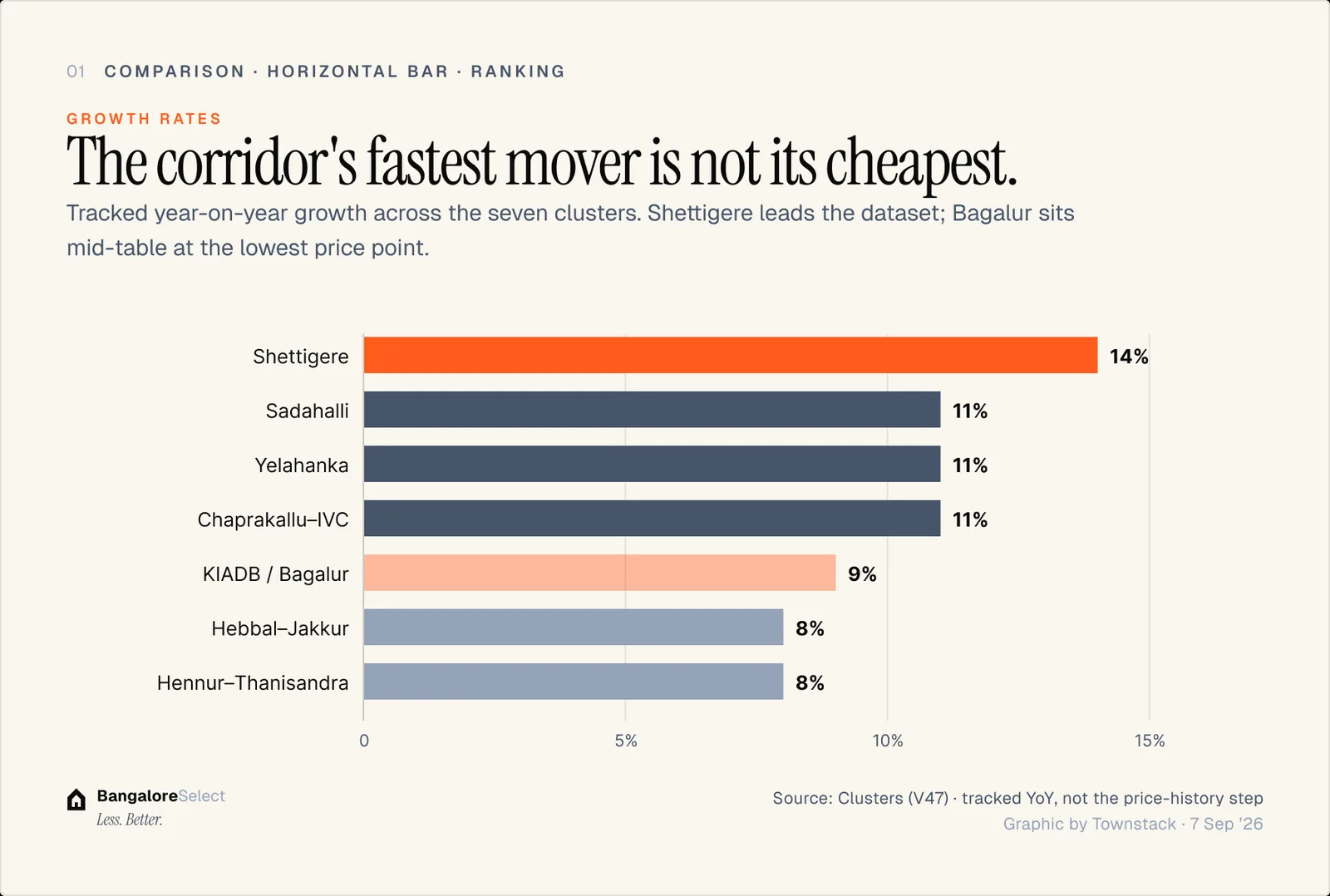
Strip away the brochures and every frontier cluster in north Bangalore is selling one of two things: proximity to where the jobs are, or proximity to how you'll reach them. KIADB–Bagalur and Shettigere are the purest expressions of each, and at ₹11,000 and ₹13,000 a square foot, they are the two cheapest ways into the airport economy that the tracked dataset offers.
KIADB–Bagalur is the employment bet with no station: Boeing's 5,500-engineer campus, Collins Aerospace, Foxconn's precision facility, SAP's 15,000-seat second campus, NTT's data-centre park, all inside or beside the aerospace belt, with the metro a 2027-and-later confidence signal rather than a commitment. Shettigere is the connectivity bet: directly on Phase 2B's airport-side first leg, June 2027 service, with the corridor's fastest tracked appreciation (14 percent) as the market's applause.
Two discounts, two theses. The interesting part is that each cluster's weakness is precisely the other one's strength.
The numbers, side by side
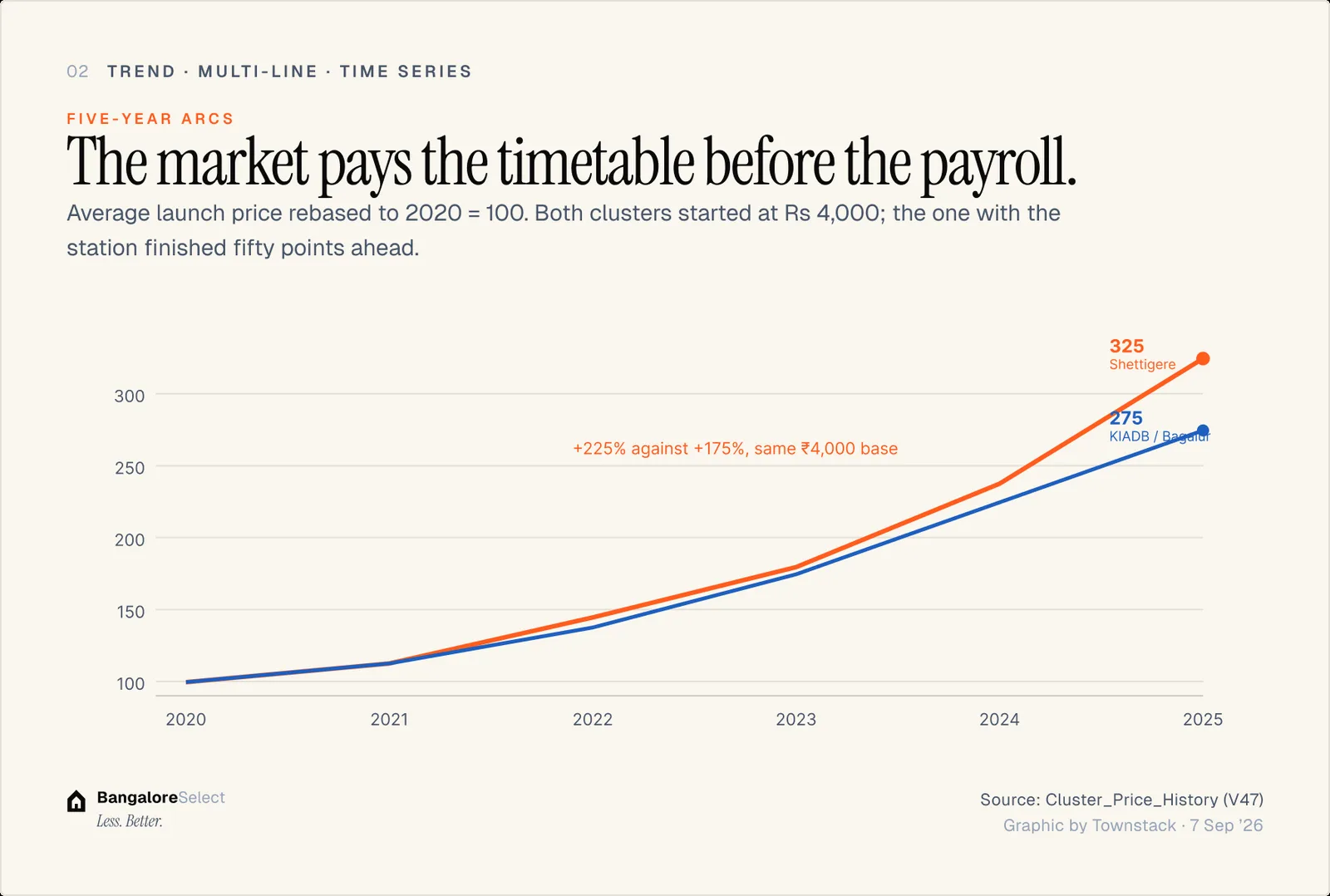
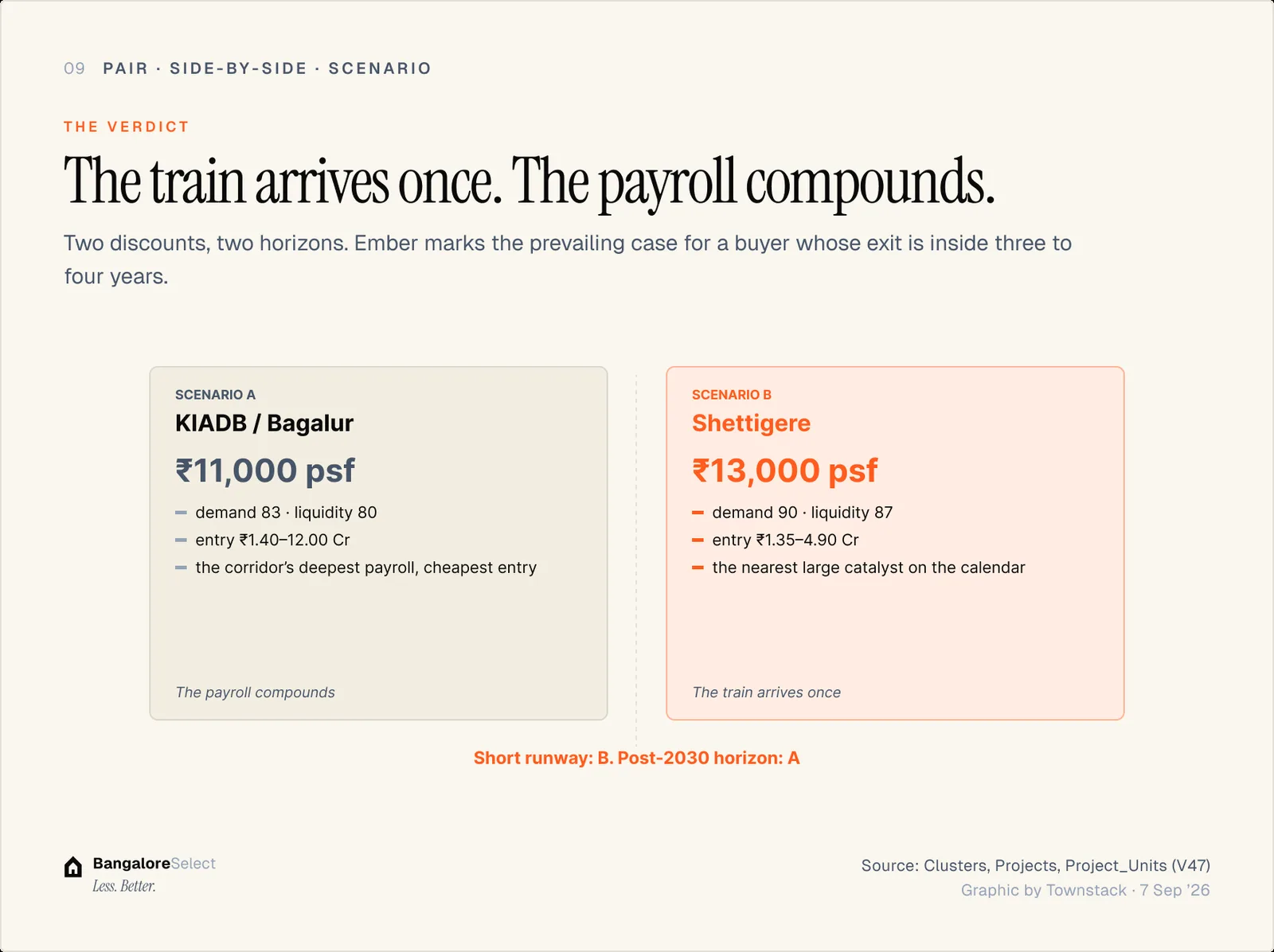
KIADB–Bagalur: ₹11,000 per square foot, 9 percent tracked growth, five-year arc 175 percent. Demand 83, Liveability 78, Liquidity 80, yield 3.1 percent. Shettigere: ₹13,000 per square foot, 14 percent tracked growth (the dataset's fastest) five-year arc 225 percent, also the dataset's steepest. Demand 90, Liveability 84, Liquidity 87, yield 3.4 percent.
Shettigere's row is simply stronger, everywhere, and the market knows it: that is what the ₹2,000 premium is. The question a buyer should actually ask is not which row wins today but which gap closes next: whether Bagalur's indices climb toward Shettigere's as the employment belt matures, or whether Shettigere's 14 percent decays toward the corridor mean once the metro premium is fully paid.
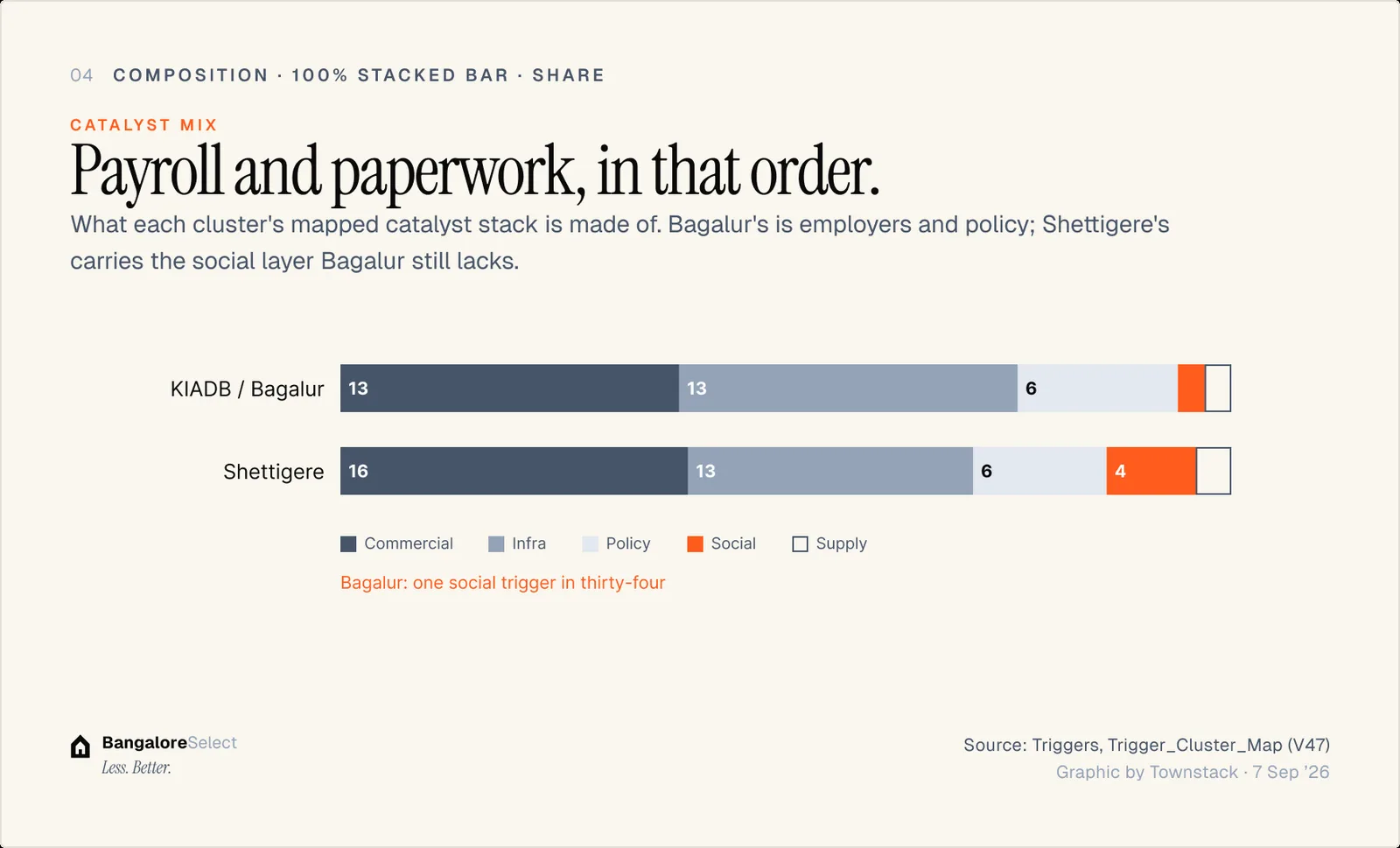
Bagalur's payroll thesis
KIADB–Bagalur's argument is a list of employers, and the list keeps lengthening. Boeing's BIETC runs 5,500 engineers. Collins Aerospace committed ₹880 crore and 2,000 aerospace jobs. Foxconn's precision engineering facility sits in the KIADB Hi-Tech Park itself. SAP Labs is building a 15,000-seat campus at ₹1,960 crore. The Devanahalli Special Investment Region: 3,117.9 acres, notified February 2026: wraps the whole belt in single-window institutional scaffolding, and the 3,000-acre Jangamakote Deep Tech Park waits twenty minutes east.
Adarsh Palm Acres and Puravankara Northern Lights give the cluster its residential range: ₹1.4 crore apartments to ₹12 crore villa plots, 2,800 units between them. The thesis is that people eventually live near where they work. It is the oldest thesis in real estate, and its weakness is only its patience: payroll accretes in years, not quarters.
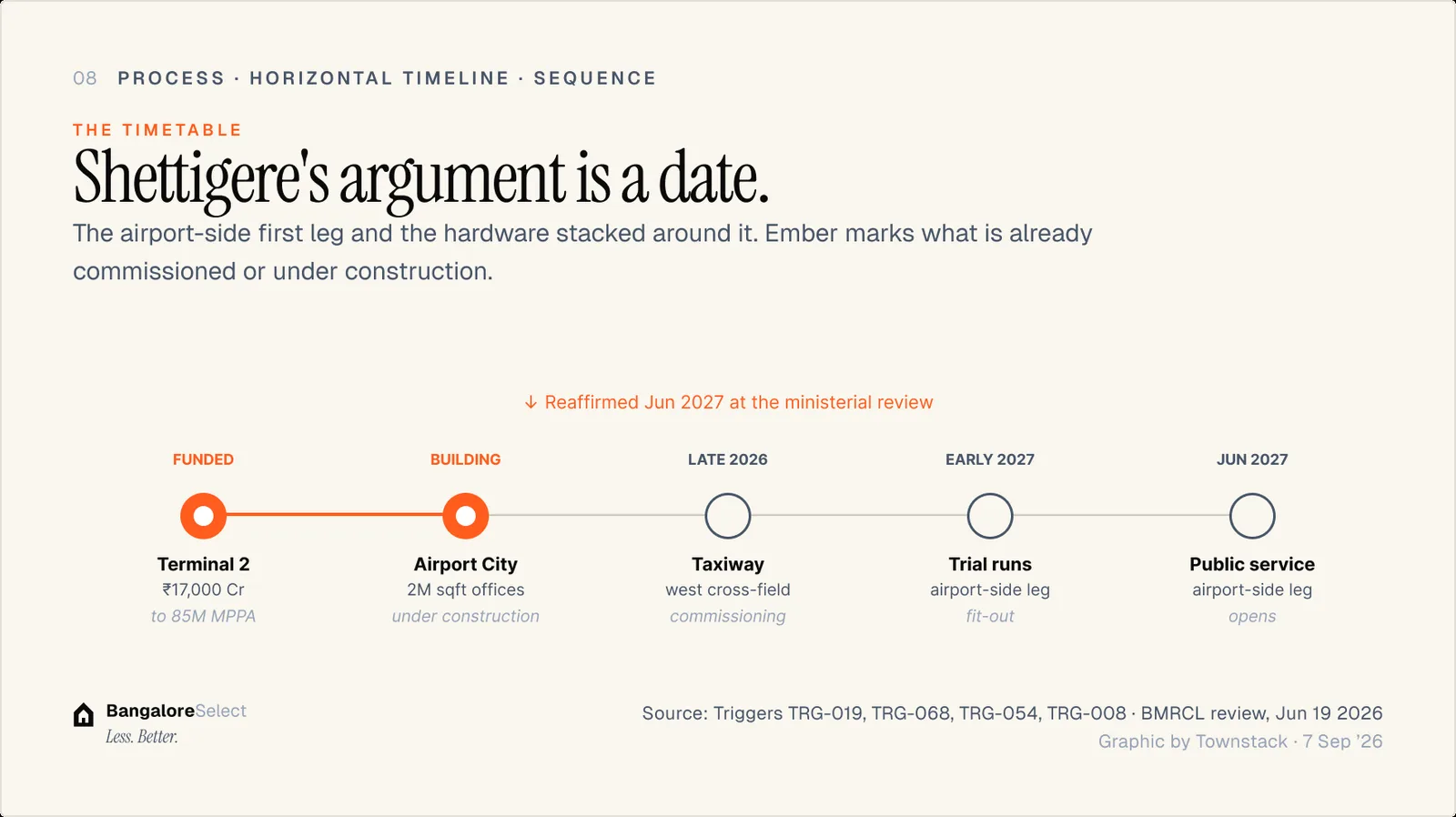
Shettigere's timetable thesis
Shettigere's argument is a date: June 2027, reaffirmed at the June 2026 ministerial review as the public-service window for the airport-side first leg that runs through this cluster's front yard. Around that date the cluster has stacked corroborating hardware: the BIAL west cross-field taxiway commissioning in late 2026, the ₹17,000 crore Terminal 2 expansion behind it, the dual-airline MRO hub's Air India leg due in early 2027 next door. And rising around the Airport City metro station one stop away, BIAL's Airport City itself: a two-million-square-foot business park under construction, India's first in-airport concert arena, and a 775-key hotel: an entire adjacent economy that isn't waiting for the train.
Birla Trimaya and Tata Varnam carry the residential book: 1,133 units from ₹1.35 to ₹4.9 crore: a supply base one-sixth of Sadahalli's, which is exactly why the 14 percent has been able to print. The weakness is symmetrical to Bagalur's: a timetable thesis is only as good as the timetable, and this corridor's city-side twin has already demonstrated, at length, what an eighteen-month reset looks like.
The convergence trade
Here is the frame that actually decides it. Shettigere at ₹13,000 has mostly converted its catalyst: the market has watched trackwork, received trainsets, and priced fourteen consecutive points of annual appreciation. What remains is the opening itself and the settling that follows. Bagalur at ₹11,000 has barely converted its catalyst: the employers are hiring, but the cluster still prices like a belt of industrial land with housing attached, because the metro-confidence leg (the Bagalur corridor signal pencilled for late 2027 and beyond) hasn't hardened into steel.
A 175 percent five-year arc against Shettigere's 225 tells you the market has consistently paid the timetable before the payroll. If you believe that ordering persists, Shettigere remains the trade. If you believe payroll eventually out-prices timetables: that 25,000 aerospace and tech salaries within ten minutes matter more by 2030 than a station opened in 2027: then Bagalur's ₹2,000 discount is the mispricing in this pair.
Shift change
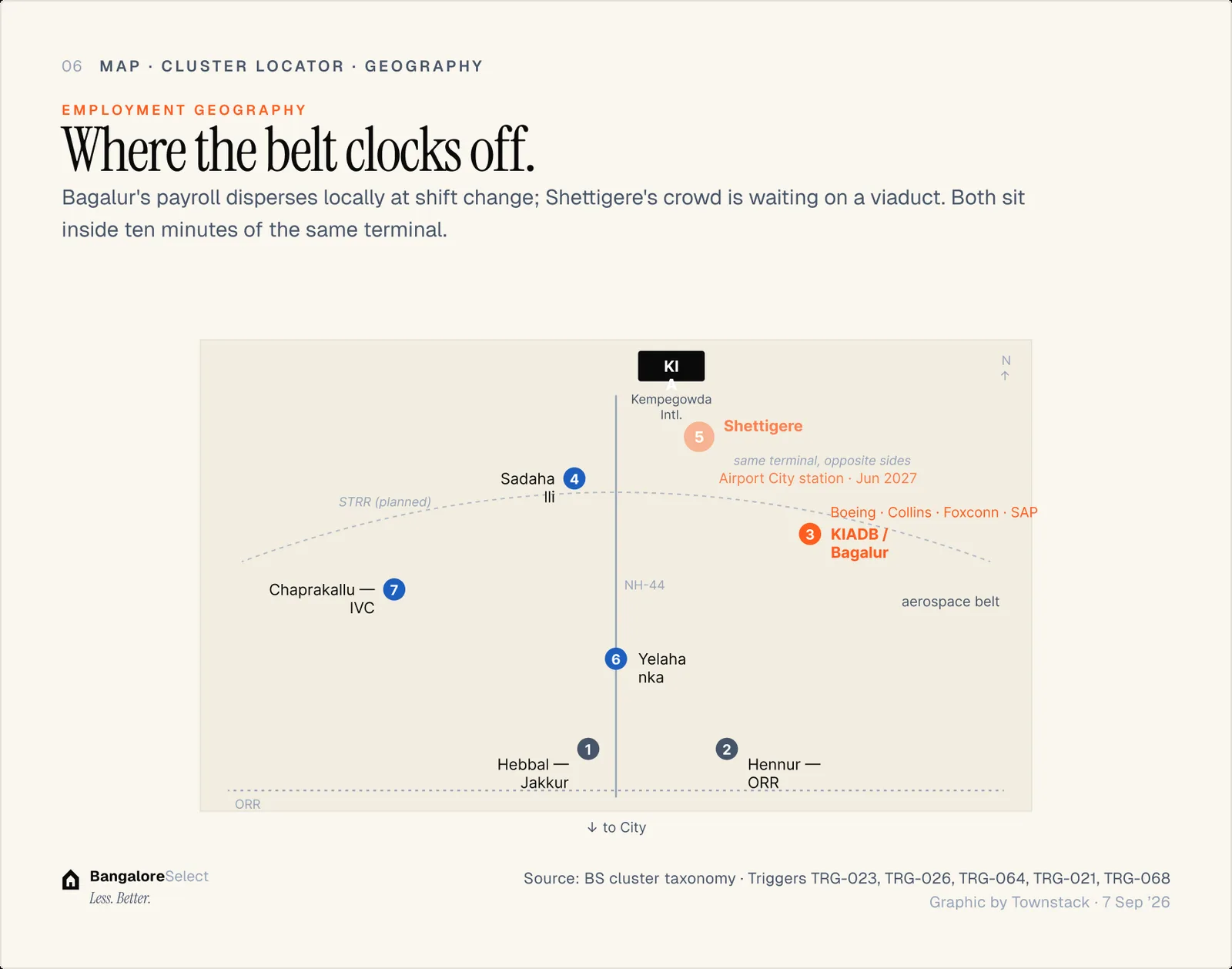
Watch the aerospace belt at shift change and Bagalur's thesis stops being abstract. The Boeing and Collins car parks empty in waves from five-thirty, and the traffic doesn't head for the city: it disperses locally, toward Bagalur town, toward the new gated communities off the KIADB spine, toward rentals whose landlords bought plots here a decade ago and are now, finally, right. These are salaries looking for addresses, and they are looking nearby.
Shettigere's equivalent scene is quieter and points the other way: evening walkers along Trimaya's edge, a viewing gallery of phone cameras wherever the metro viaduct crosses the road, everyone measuring the distance from their tower to the future station in strides. Bagalur's crowd already has the jobs and awaits the neighbourhood. Shettigere's crowd already has the neighbourhood and awaits the train. Both are getting what they're waiting for. The order of arrival is the trade.
The verdict
If you need the shorter runway (possession, tenancy, resale inside three to four years) take Shettigere. Demand 90 and Liquidity 87 mean you can leave when you want to, and the June 2027 opening is the nearest large catalyst left on the corridor's calendar.
If your horizon is 2030 and beyond, and especially if your household draws a salary from the belt itself, take Bagalur. You are buying the corridor's deepest employment story at its lowest tracked price, and every year the belt hires, the discount you paid narrows.
The train arrives once. The payroll compounds. Short money follows the first; patient money has always been paid for backing the second.
Sources. BangaloreSelect Tracked Dataset (BS_AutoResearch V47, 06-SEP-2026 working file). Phase 2B airport-side leg June 2027: BMRCL ministerial review, June 19, 2026. Devanahalli SIR notification: Karnataka Gazette, February 2026. Boeing BIETC, Collins Aerospace CIOC, SAP Labs Devanahalli, Foxconn Arebinnamangala: company and Karnataka Government announcements, 2024–2025. BIAL Airport City build-out (business park, arena, hotels): BIAL announcements, 2026. STRR Dobbaspet–Hoskote arc: NHAI, inaugurated March 2024.
Read more on the KIADB / Bagalur cluster page and the Shettigere Cluster cluster page for the live project list, trigger feed and price-history chart referenced in this article.