The ₹5,000 Question: What Hebbal–Jakkur Has That Sadahalli Is Still Buying
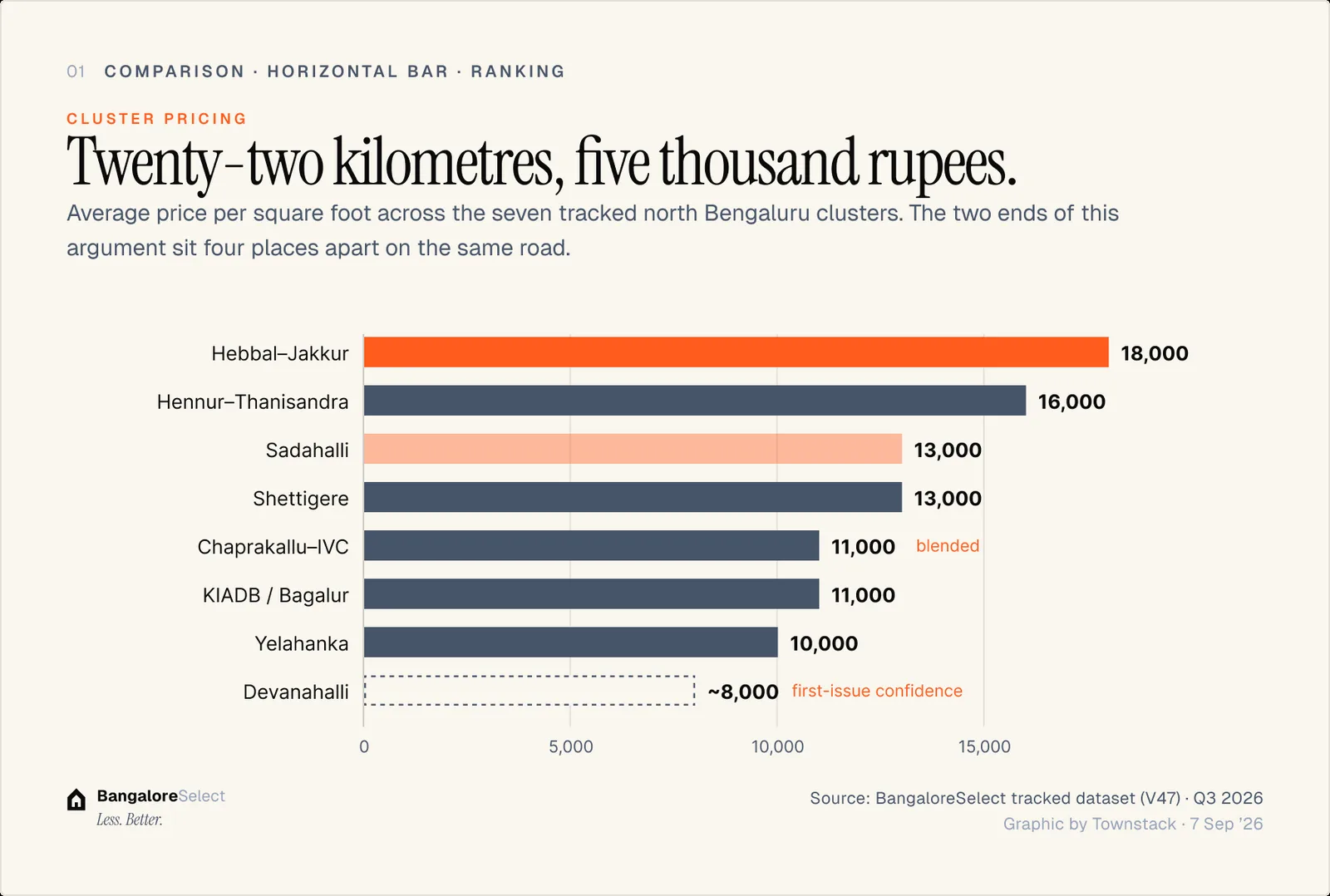
Drive north from Hebbal Junction on NH-44 and you cross the whole argument in twenty-two kilometres. At the southern end, ₹18,000 a square foot buys you a cluster where the flyover loop is open, the tech park is full, and the anchor tenant has a signed lease.
Drive north from Hebbal Junction on NH-44 and you cross the whole argument in twenty-two kilometres. At the southern end, ₹18,000 a square foot buys you a cluster where the flyover loop is open, the tech park is full, and the anchor tenant has a signed lease. At the northern end, near the Sadahalli toll plaza, ₹13,000 buys you a cluster where the metro stations are under trackwork, the underpass is being built at night, and the largest residential launch in Bengaluru's history is still counting bookings.
The ₹5,000 gap between them is the most honest number in north Bangalore. It is the market's price for the difference between infrastructure that exists and infrastructure that is scheduled.
Most buyers comparing these two clusters frame it as premium versus value. That's the wrong frame. Both are premium corridors. The real comparison is between a premium that has finished forming and one that is still in the oven, and the two require entirely different stomachs.
The numbers, side by side
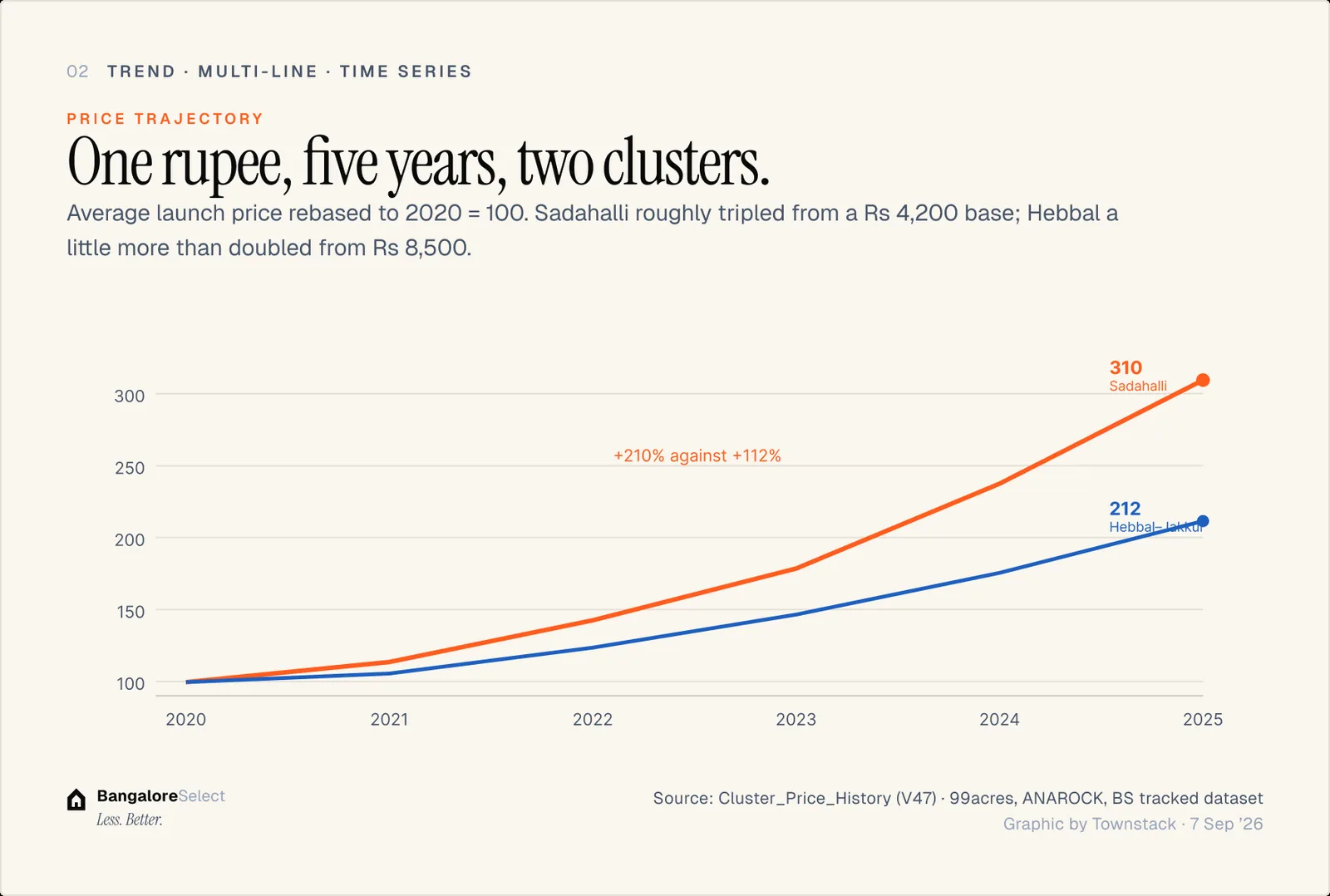
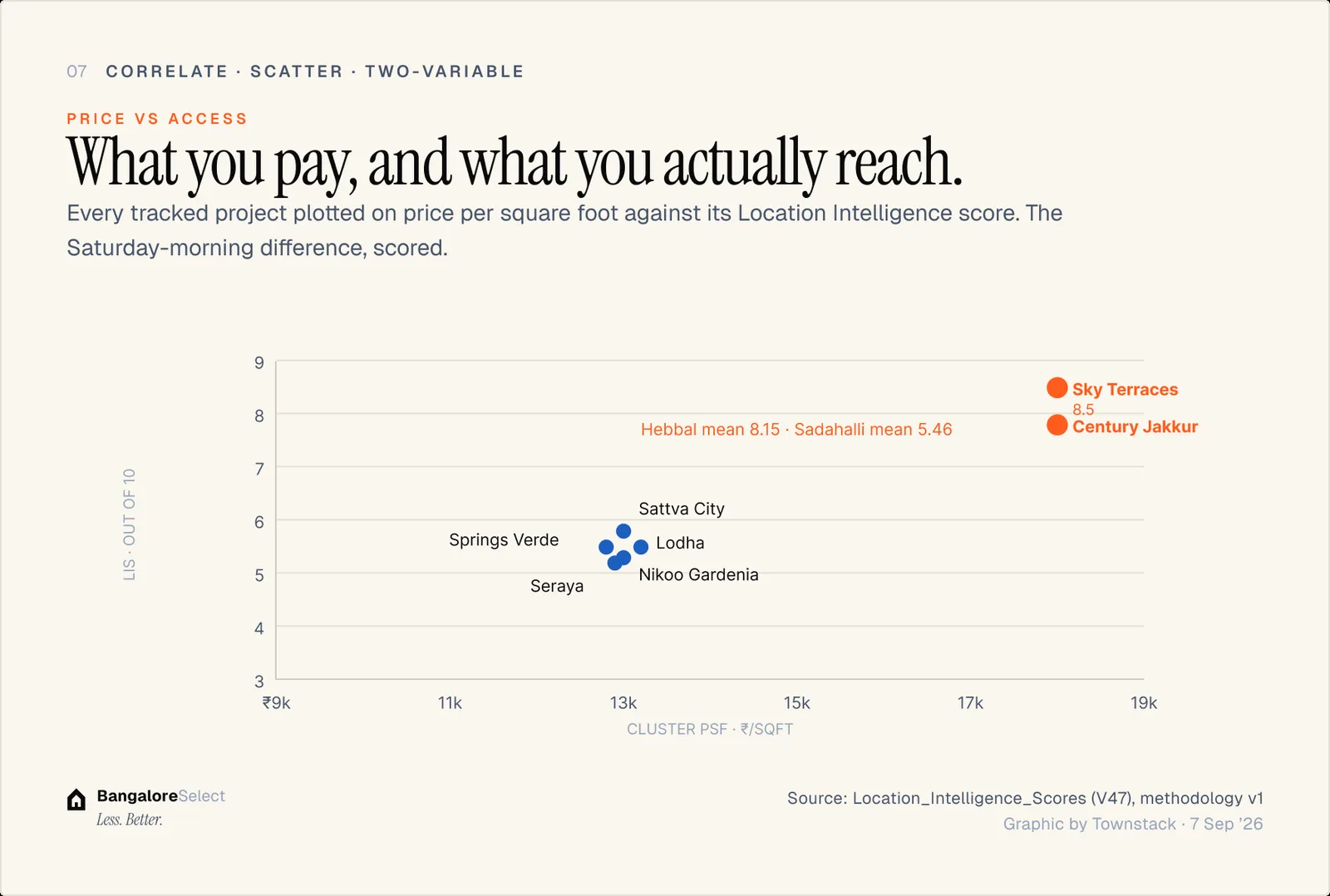
Hebbal–Jakkur: ₹18,000 per square foot, 8 percent tracked year-on-year growth, a five-year arc of 112 percent. Demand Index 90, Liveability 90, Liquidity 87, rental yield 3.4 percent. Sadahalli: ₹13,000 per square foot, 11 percent tracked growth, a five-year arc of 210 percent. Demand 83, Liveability 78, Liquidity 80, yield 3.0 percent.
Read those two rows carefully, because they tell opposite stories at the same time. Hebbal wins every present-tense metric: demand, liveability, liquidity, yield. Sadahalli wins every rate-of-change metric. Over five years, ₹1 crore parked in Sadahalli roughly tripled while the same crore in Hebbal slightly more than doubled. That is not because Sadahalli is the better cluster. It is because Sadahalli started from a ₹4,200 base in 2020 and had a metro announced through the middle of it. For calibration: Devanahalli, the tracked set's new eighth cluster around the airport itself, enters the corridor ladder at roughly ₹8,000 blended, on first-issue, low-confidence sourcing.
What Hebbal has that money can't schedule
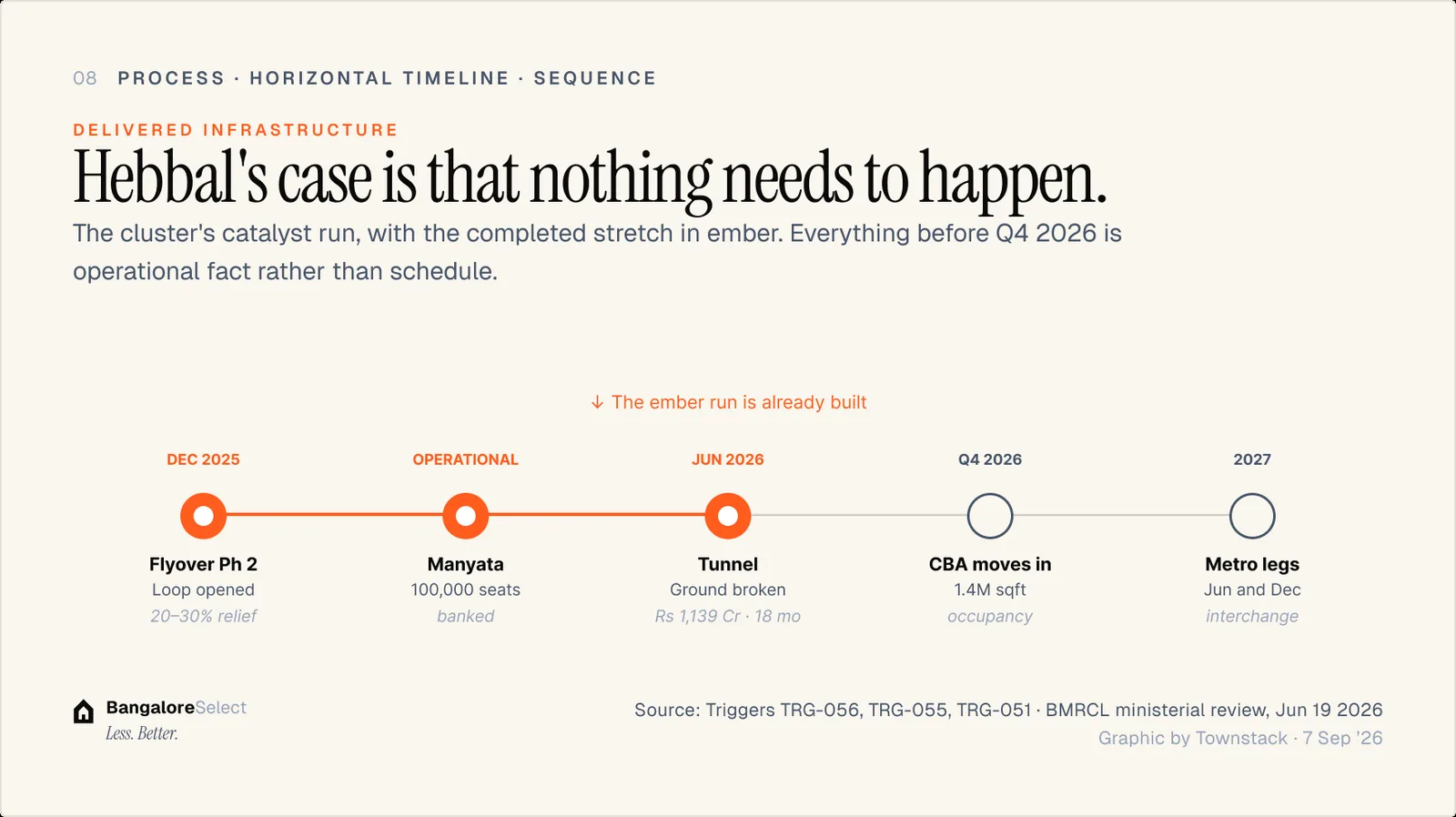
Hebbal's case is that nothing needs to happen. The Hebbal Flyover Phase 2 loop opened in December 2025 and is delivering measurable junction relief today. Manyata's 100,000-seat GCC base is operational, and Commonwealth Bank of Australia's 1.4 million square foot built-to-suit at Embassy Manyata (Q4 2026 occupancy) converts the tenant-depth question into a named principal. The ₹1,139 crore Hebbal–Mekhri tunnel broke ground in June 2026 with an 18-month contractual deadline.
The cluster's two active projects, Century Jakkur and Embassy Sky Terraces, price between ₹4.25 and ₹6.6 crore. That is the cost of admission, and it buys a floor built on things that already exist. The metro, when it arrives at the Hebbal interchange in 2027, is upside on top of a thesis that no longer depends on it.
What Sadahalli has that Hebbal already spent
Sadahalli's case is that everything is about to happen, and unusually for Bangalore, most of it has a date with money behind it. The airport-side first leg of Phase 2B (which carries the Doddajala and Chikkajala stations that serve this cluster directly) was reaffirmed for June 2027 public service at the June 2026 ministerial review. The Sadahalli underpass, the last traffic signal on the 22-kilometre Hebbal–airport run, has night construction crews on it now under a ₹35 crore NHAI award. And the corridor's first large-format mall (Prestige's Forum 13° North, with its 185-key W Hotel) is rising on Sadahalli Main Road itself, due across 2026-27.
When a cluster's two defining catalysts are both under physical construction rather than in a press release, the appreciation rate that follows tends to hold. Sadahalli's 11 percent is the market pricing that arithmetic in real time. Hebbal's 8 percent is what the same arithmetic looks like after it has finished.
The supply asymmetry nobody prices
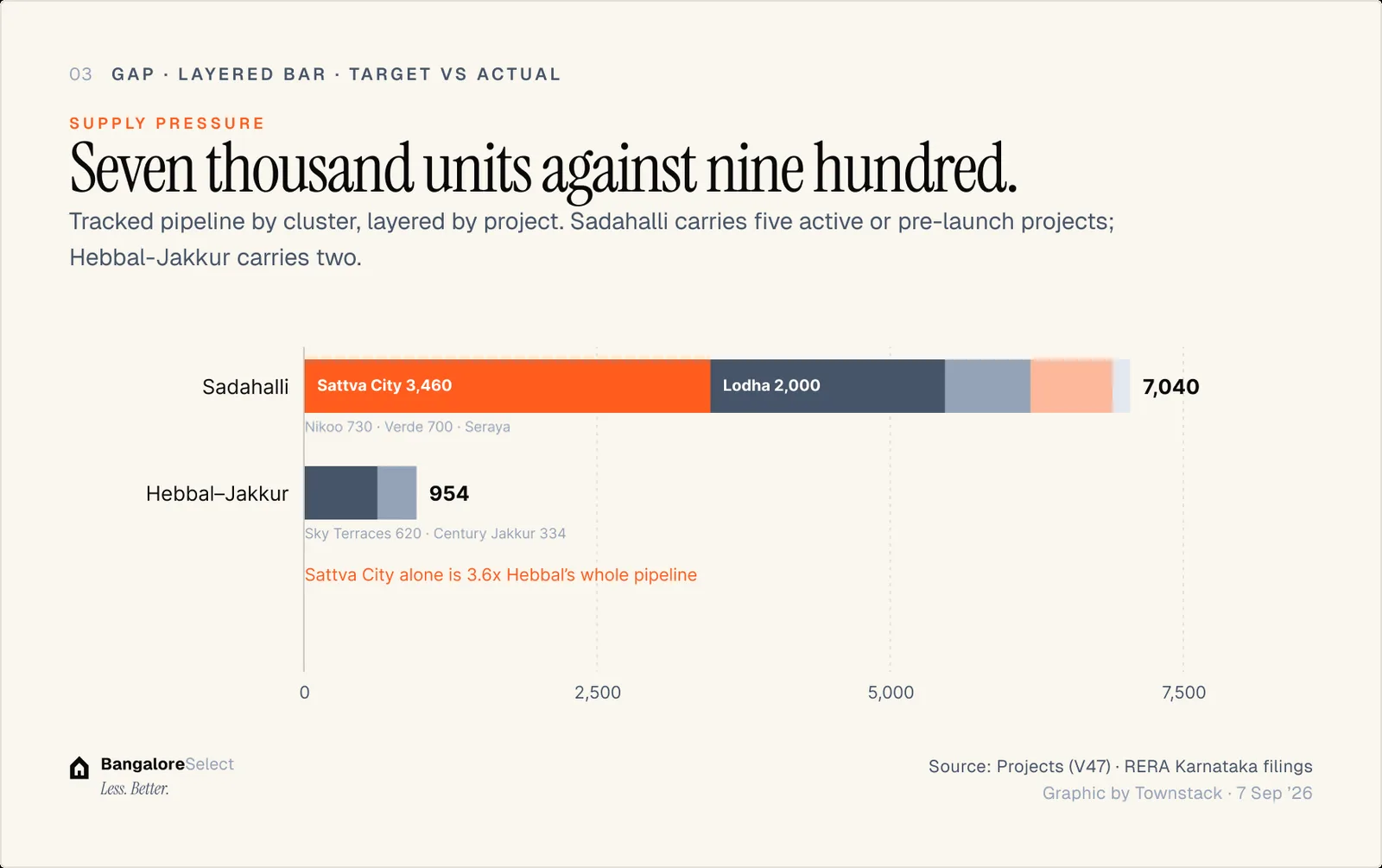
Here is the number that should give the Sadahalli buyer pause: the cluster carries five active or pre-launch projects totalling roughly 7,000 units. Sattva City alone is 3,460 apartments, and Lodha Sadahalli adds 2,000 more on 70 acres. Hebbal–Jakkur's entire tracked pipeline is 954 homes across two projects.
Seven thousand units arriving into one micro-market is three to four years of typical absorption even at north Bangalore's current pace. If the metro opens on schedule, that supply gets eaten. If it slips (and Bangalore metro history is not short of slips), Sadahalli's sellers will be competing with each other in a way Hebbal's 954-unit market structurally cannot. Scarcity is a feature you buy, and Hebbal is the only one of the two selling it.
Two Saturday mornings
Spend a Saturday morning in each cluster and the spreadsheets acquire faces. In Jakkur, the morning belongs to residents: cyclists doing loops past the aerodrome, a queue outside the lake-view café, families who bought in 2019 walking dogs past families who bought in 2024. Nobody is touring anything. The cluster's transaction volume happens quietly, through brokers, between people who already know what Hebbal is worth.
At Sadahalli, Saturday morning belongs to the sales galleries. Sattva City's parking fills by eleven. Lodha's mock-up flat receives its scheduled convoys. The crowd is younger, the questions are about possession dates and payment plans, and at least one visitor per hour asks the relationship manager, carefully, exactly where the metro station will be. Both scenes are healthy. But only one of them is a market; the other is still an audience.
The verdict
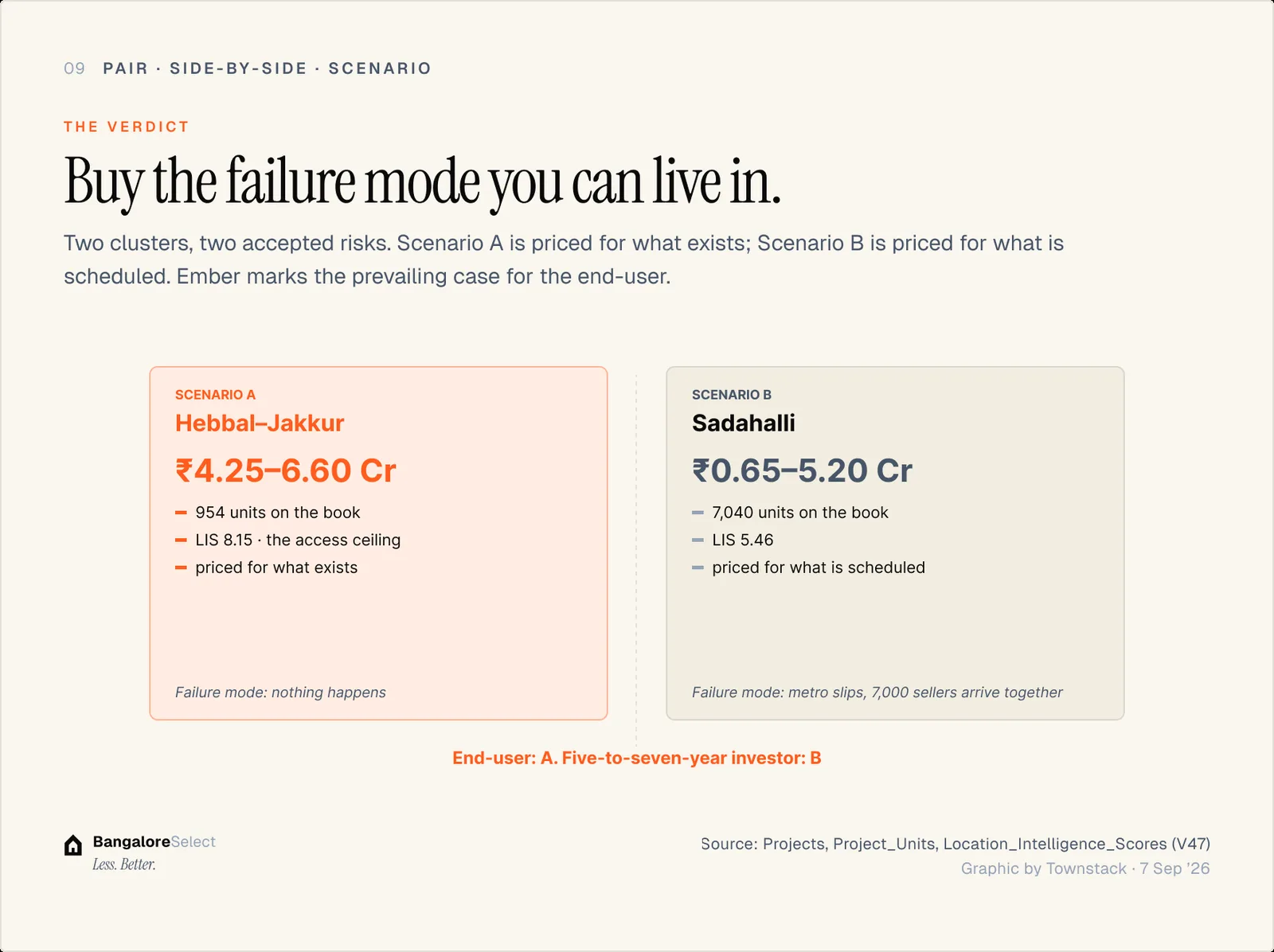
If you are an end-user with a ₹4 crore-plus budget who needs the commute, the schools, and the hospital to work from possession day, buy Hebbal–Jakkur and pay the ₹18,000. You are buying the absence of execution risk, which is the one thing Sadahalli cannot sell you at any price.
If you are an investor with a five-to-seven-year horizon who can tolerate a construction-phase corridor, Sadahalli's case is genuinely strong: stations under trackwork, an underpass under lights, and a ₹5,000 discount to the cluster it is converging toward. But size the position knowing that 7,000 units are coming with you.
And if you are choosing between them with an end-user's timeline and an investor's budget, the tiebreak is simple: Hebbal is priced for what it is. Sadahalli is priced for what it should become. Buy the one whose failure mode you can live in.
Sources. BangaloreSelect Tracked Dataset (BS_AutoResearch V47, 06-SEP-2026 working file). Phase 2B airport-side leg June 2027 reaffirmation: BMRCL ministerial review, June 19, 2026. Sadahalli underpass award and night-work permission: NHAI / Bengaluru Traffic Police, July 2026. Embassy Manyata CBA built-to-suit: Embassy REIT investor disclosure. Hebbal–Mekhri tunnel ground-breaking: Karnataka Government, June 27, 2026. Forum 13° North location (Sadahalli Main Road, Devanahalli 562157): Prestige Group collateral.
Read more on the Hebbal\u2013Jakkur cluster page and the Sadahalli Cluster cluster page for the live project list, trigger feed and price-history chart referenced in this article.