The Two Sensible Choices: Hennur–Thanisandra vs Yelahanka, and Why They're Not the Same Kind of Sensible
Every north Bangalore shortlist has a sensible option on it: the cluster the buyer picks after deciding the premium corridors are overheated and the frontier corridors are overpromised. The problem is that north Bangalore has two clusters competing for that slot, and they are sensible in opposite ways.

Every north Bangalore shortlist has a sensible option on it: the cluster the buyer picks after deciding the premium corridors are overheated and the frontier corridors are overpromised. The problem is that north Bangalore has two clusters competing for that slot, and they are sensible in opposite ways.
Hennur–Thanisandra is the city's sensible choice: ₹16,000 a square foot, mature stage, Liveability 90, wired into the Outer Ring Road office economy, with its own metro stations on the way. Yelahanka is the corridor's sensible choice: ₹10,000 a square foot (the lowest entry in the tracked dataset) for an established town with a working high street, a tertiary hospital, and an Amazon headquarters that moved in next door.
Same instinct, different products. One is a discount on the city. The other is a discount on the airport corridor. Which sensible you want depends on which direction your life points.
The numbers, side by side
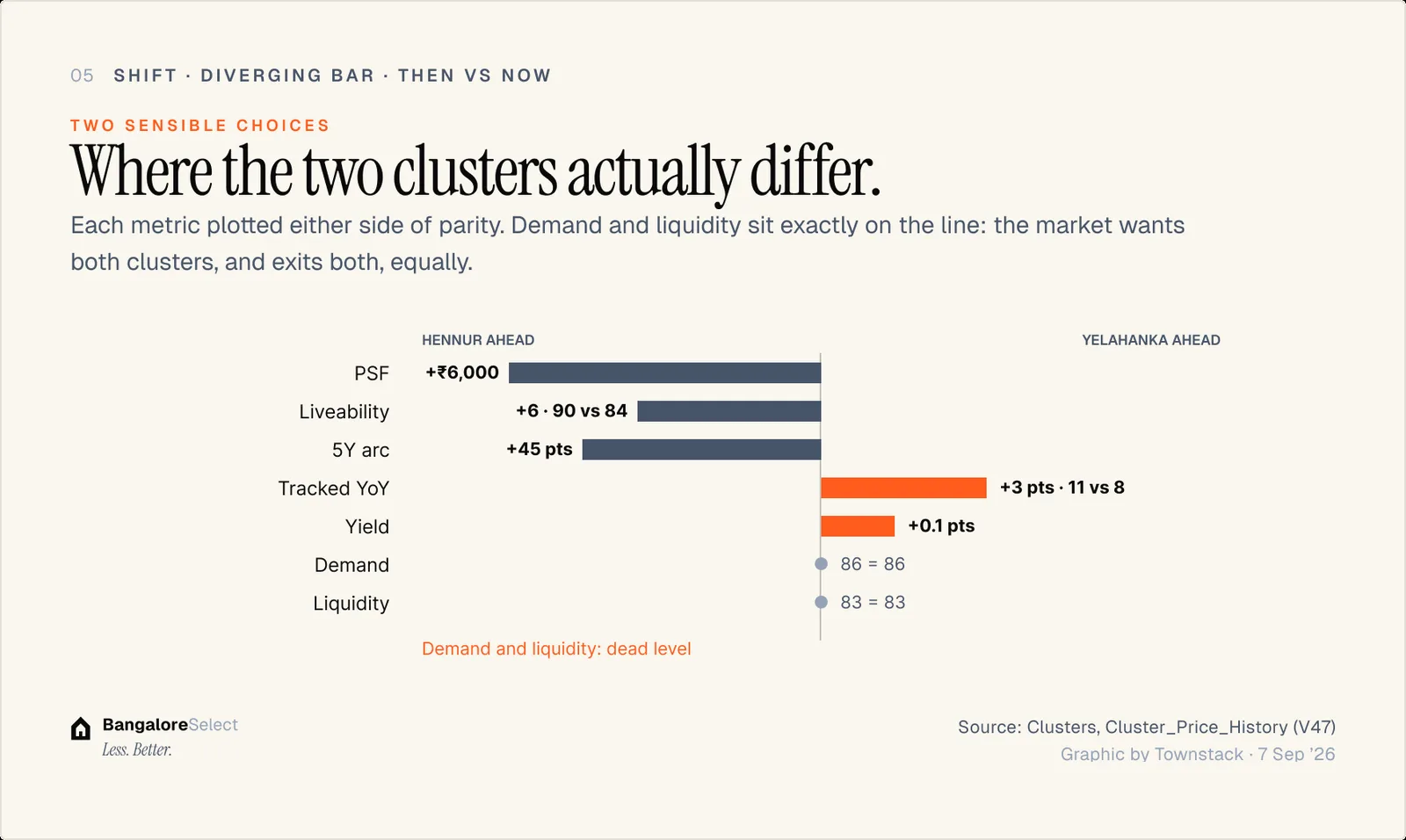
Hennur–Thanisandra: ₹16,000 per square foot, 8 percent tracked year-on-year growth, five-year arc 167 percent. Demand 86, Liveability 90, Liquidity 83, yield 3.0 percent. Yelahanka: ₹10,000 per square foot, 11 percent tracked growth, five-year arc 122 percent. Demand 86, Liveability 84, Liquidity 83, yield 3.1 percent.
Notice what's identical: demand and liquidity. The market wants both clusters equally and exits both clusters equally well. The entire decision therefore lives in the two numbers that differ (the ₹6,000 price gap and the six-point liveability gap) and in one fact the table doesn't show: whose infrastructure calendar you'd rather be holding.
Hennur's calendar problem
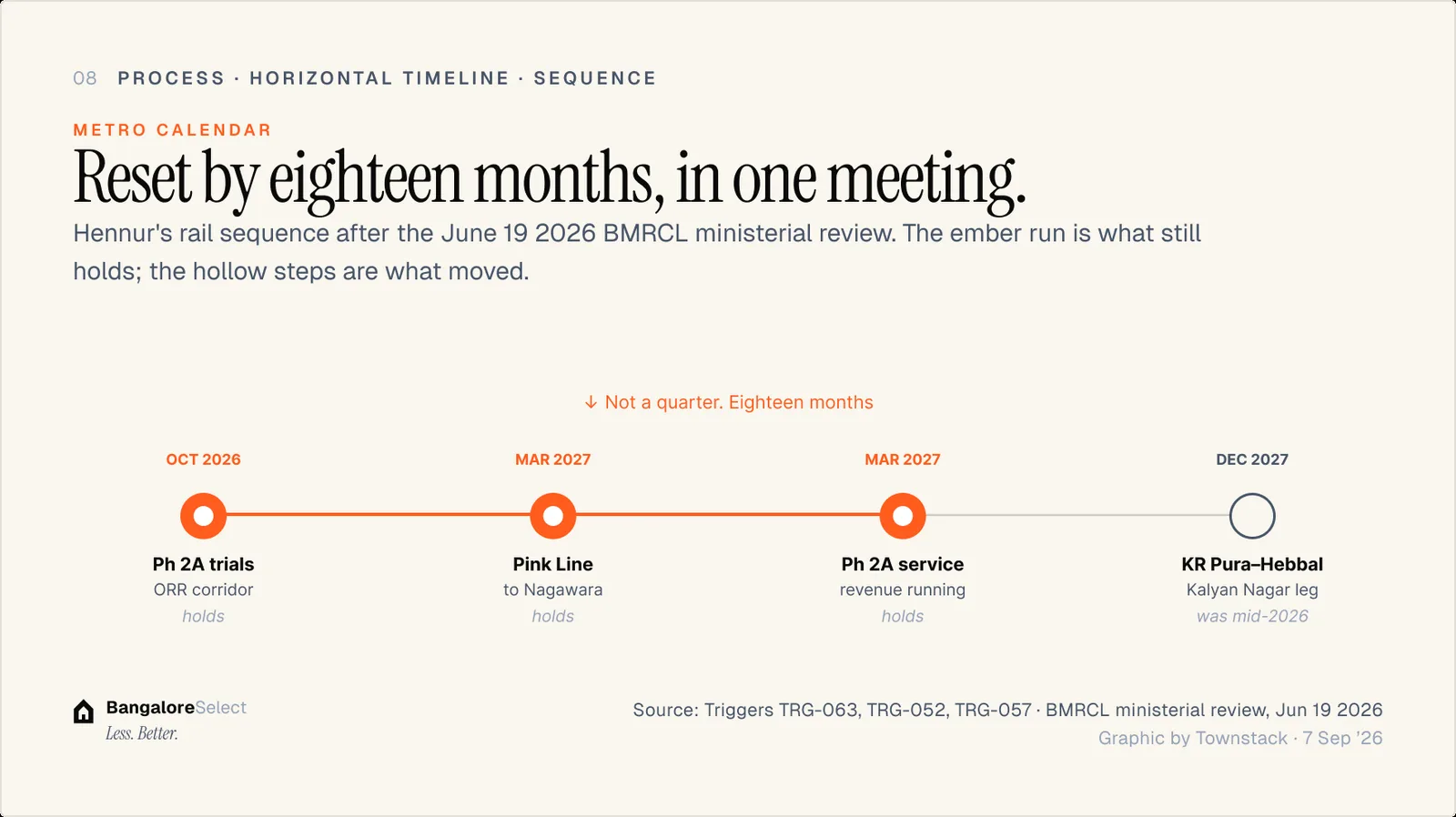
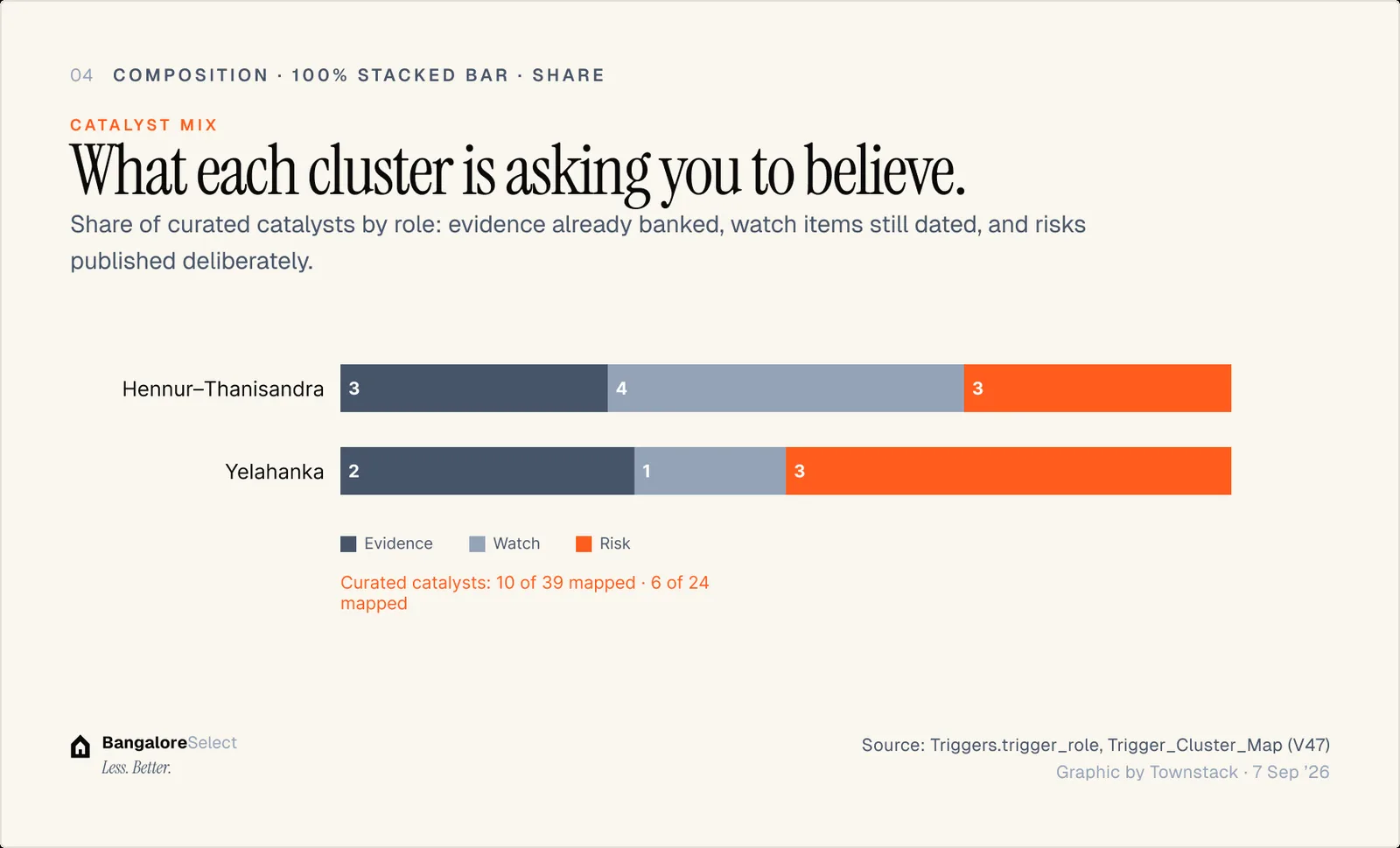
Hennur–Thanisandra's metro story took the corridor's hardest single revision this year. At the June 2026 BMRCL review, the entire KR Pura–Hebbal segment (the one carrying Kalyan Nagar, HRBR, and HBR Layout, the stations this cluster's pricing had been leaning on) was reset to December 2027. Not slipped by a quarter. Reset, by eighteen months, in one meeting.
The cluster absorbed it better than it might have, because the thesis was never metro-only: the ORR office spillover is real, Embassy Manyata's CBA anchor sits at its doorstep, and the Nagawara Pink–Blue interchange still lands in 2027. But a buyer entering at ₹16,000 today is paying near-Hebbal money for a metro that is now two full years away. That is the specific bill Hennur hands you at the door.
Yelahanka's quieter arithmetic
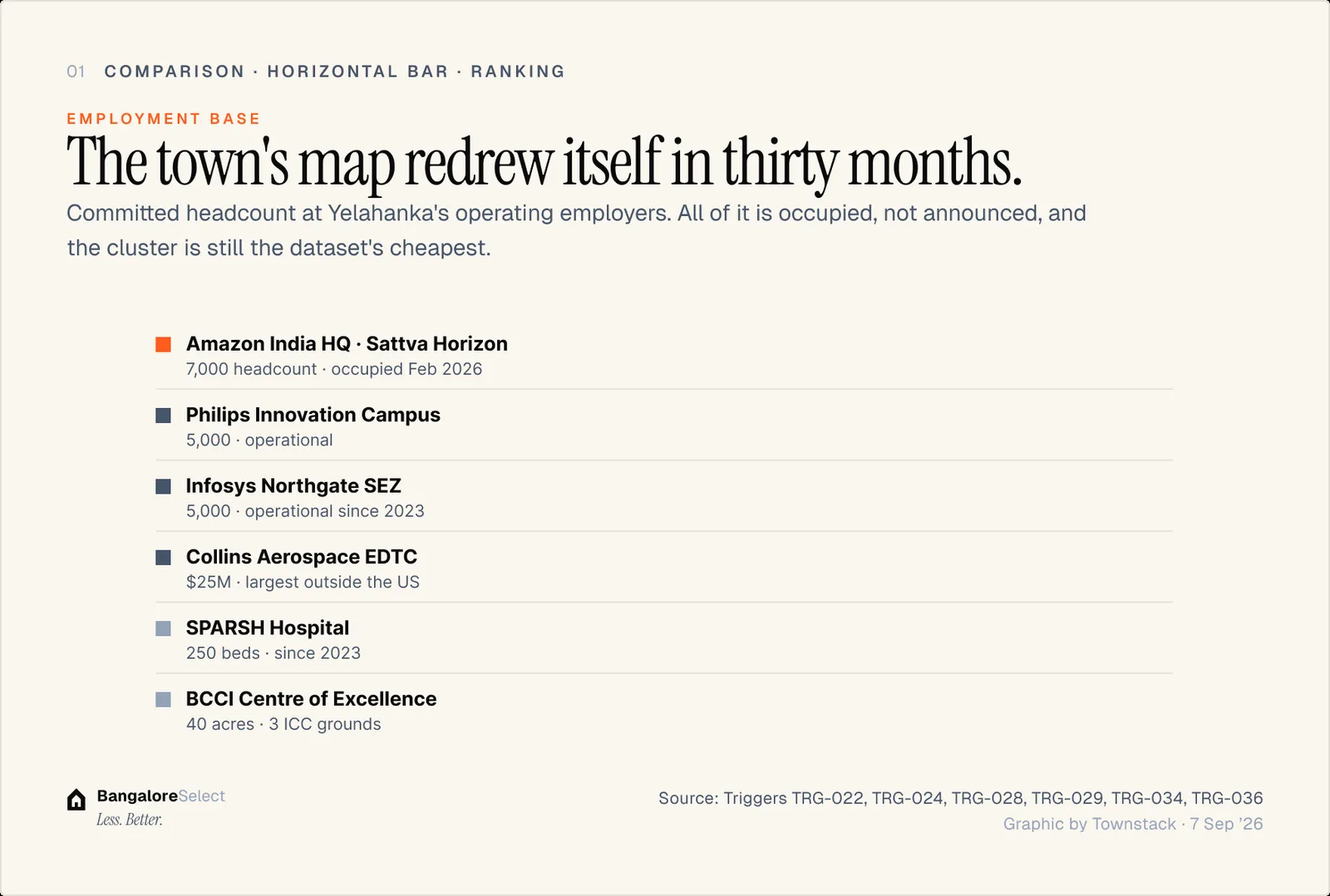
Yelahanka's stations are on the other Phase 2B leg: the airport-side one, reaffirmed for June 2027 service, which carries Bagalur Cross. Its calendar risk is the corridor's lowest, because less of the price depends on the calendar at all. The town has existed for decades. SPARSH's 250-bed hospital is open. The BCCI Centre of Excellence is open. Amazon's 7,000-employee India headquarters at Sattva Horizon is occupied. What the town still lacks is a large-format mall: the corridor's first, Prestige's Forum 13° North, is rising fifteen minutes up the highway on Sadahalli Main Road, an amenity Yelahanka will reach without hosting.
The active projects. Century Kindle from ₹1.1 crore, Assetz Sanctum at ₹2 crore, Godrej Aveline to ₹3.9 crore: price a full tier below Hennur's ₹3.2-to-4.3 crore pre-launches. You are not buying a frontier here. You are buying the finished version of what the frontier clusters are promising to become, at the lowest entry in the dataset.
What each buyer is actually underwriting
The Hennur buyer underwrites the ORR office economy: Manyata occupancy, the CBA lease converting to occupied desks in Q4 2026, and the December 2027 metro date holding. If those hold, ₹16,000 converges toward Hebbal's ₹18,000 and the cluster's 167 percent five-year arc keeps compounding. If the metro slips again, the premium over Yelahanka gets harder to defend each quarter.
The Yelahanka buyer underwrites something slower and sturdier: that an established town at ₹10,000, sitting between the city and an airport economy adding Amazon, Philips, Infosys, and an aerospace belt, does not stay the cheapest cluster in the dataset forever. The 11 percent growth rate says the market has started to agree. The risk is the opposite one: that 'established' means most of the easy appreciation already happened, a suspicion the 122 percent five-year arc, the gentlest of any mid-stage cluster on the corridor, quietly supports.
The 6 PM test
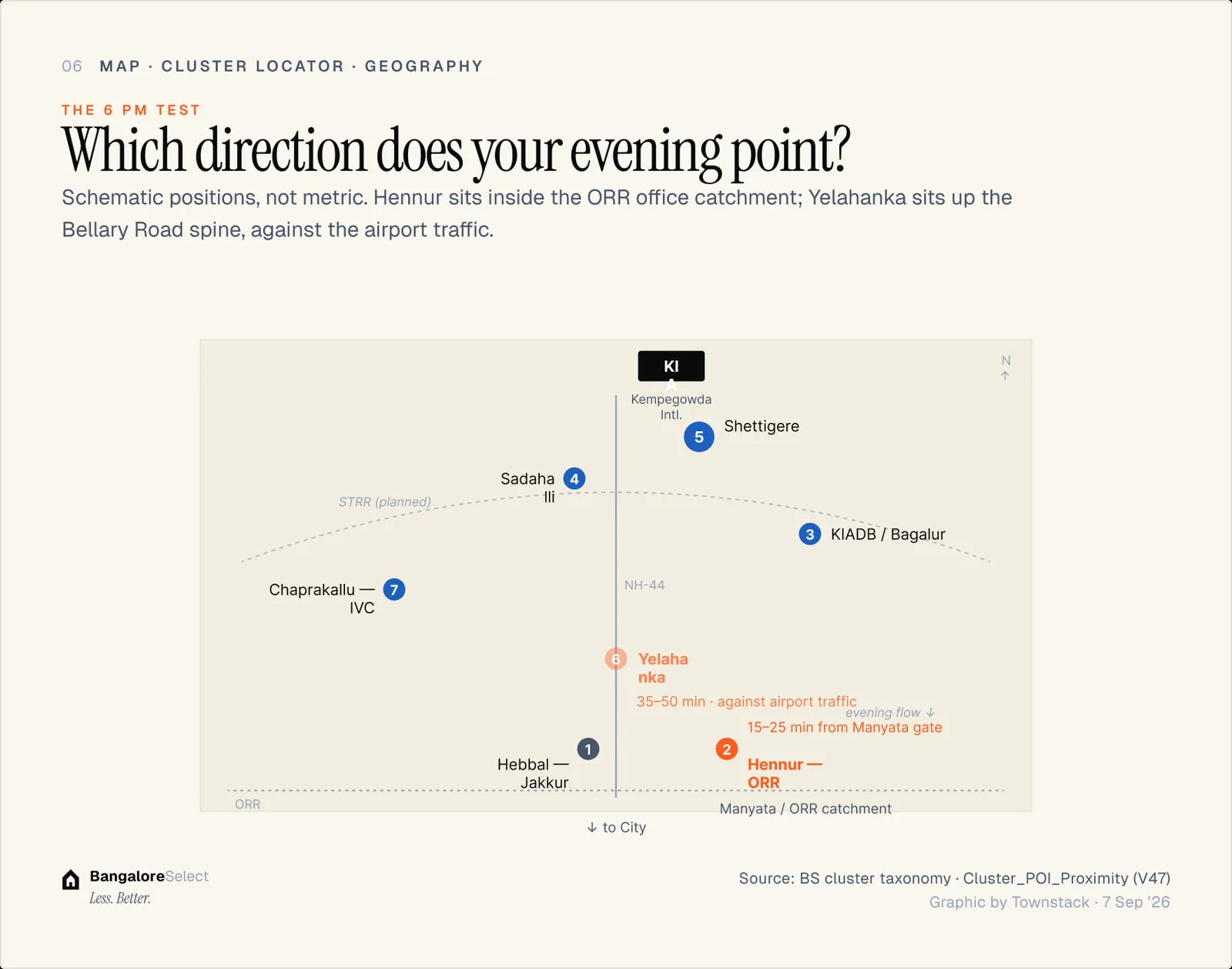
Run both clusters through the same weekday evening. From a Manyata exit gate at six, Thanisandra Road is fifteen to twenty-five minutes of stop-start to most of the cluster's front doors: annoying, survivable, and improving at the margin as the Nagawara works progress. The reward at the end is a neighbourhood that has everything within two kilometres: the school, the supermarket chains, three hospitals' worth of options, and dinner you didn't cook.
From the same gate, Yelahanka is thirty-five to fifty minutes up Bellary Road, against the airport traffic. The reward is different in kind: a town where the evening actually ends: quieter streets, the Air Force campus's permanent green wall, dinner on a high street that predates the word 'corridor'. Hennur optimises the commute. Yelahanka optimises what the commute is for. Buyers who take the 6 PM test usually stop needing the spreadsheet.
The verdict
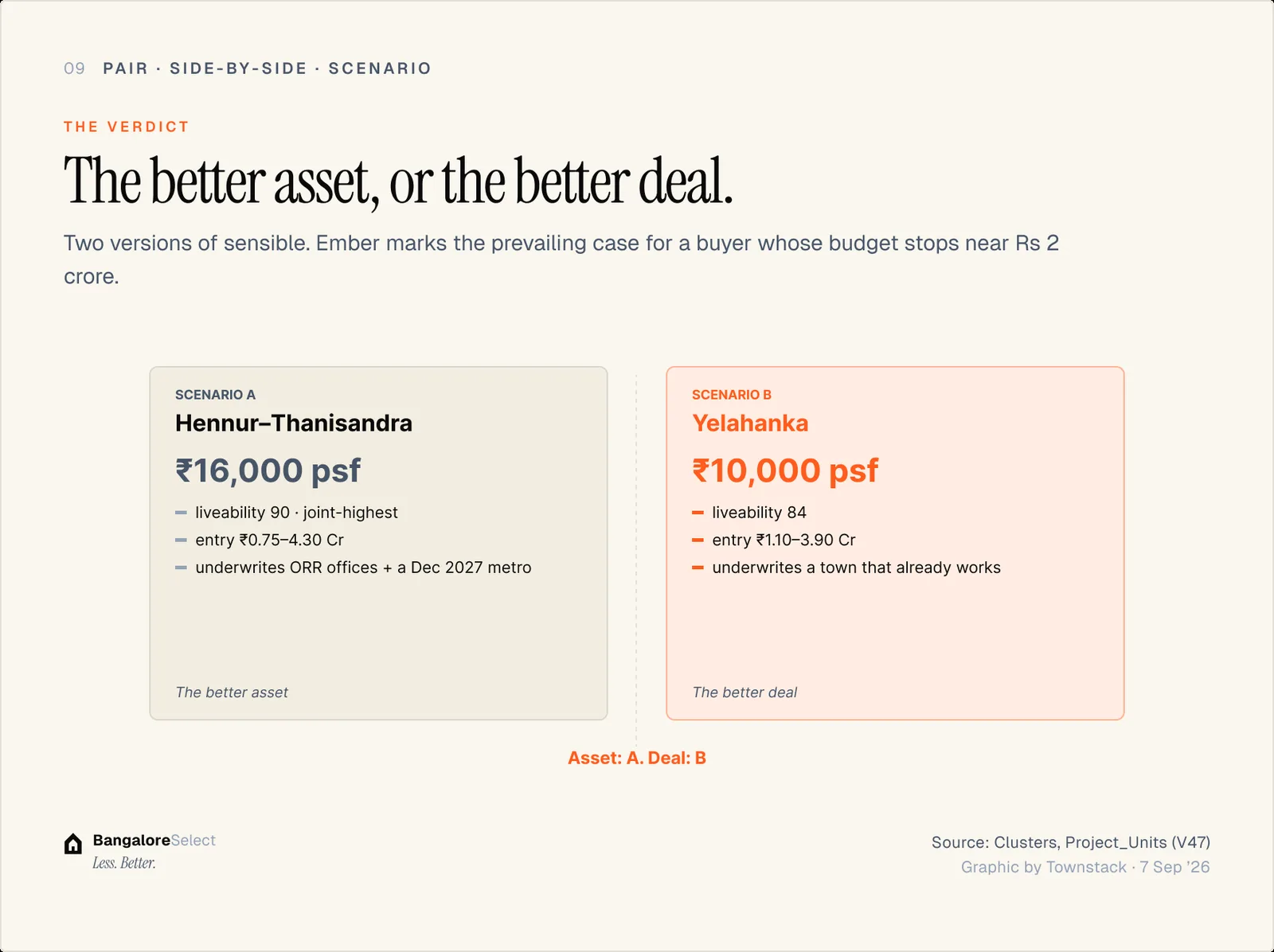
If your commute points south (ORR, Manyata, the city) and your budget clears ₹3 crore, Hennur–Thanisandra is the right sensible, provided you buy it knowing the metro is a December 2027 event and price your patience accordingly.
If your life points north (airport, aerospace belt, a school run you'd like to finish before the second bell) or your budget stops nearer ₹2 crore, Yelahanka is not the compromise it looks like on a PSF table. It is the only cluster in the dataset where you can buy a functioning town at a frontier price.
The honest tiebreak: Hennur is the better asset, Yelahanka is the better deal. Buyers who confuse those two categories usually end up owning the right cluster in the wrong decade.
Sources. BangaloreSelect Tracked Dataset (BS_AutoResearch V47, 06-SEP-2026 working file). KR Pura–Hebbal December 2027 reset and airport-side leg June 2027 reaffirmation: BMRCL ministerial review, June 19, 2026. Amazon India HQ at Sattva Horizon, Yelahanka: company announcement, February 2026. Forum 13° North + W Hotel (Sadahalli Main Road, Devanahalli corridor): Prestige Group project disclosures.
Read more on the Hennur–Thanisandra Road cluster page and the Yelahanka cluster page for the live project list, trigger feed and price-history chart referenced in this article.
Want our next North Bangalore report in your Google results? Add BangaloreSelect as a preferred source and new reports show up in your Top Stories.