Two Kilometres or Eleven: the One Distance That Is a Veto
For most buyers on this corridor, distance to a hospital is a line item. It sits in a list alongside the mall and the metro, it contributes to a score, and it is traded off against price like everything else.
For most buyers on this corridor, distance to a hospital is a line item. It sits in a list alongside the mall and the metro, it contributes to a score, and it is traded off against price like everything else.
For you it is not a line item. It is the difference between an ambulance arriving in eight minutes and in twenty-five, and no amount of clubhouse makes up the difference.
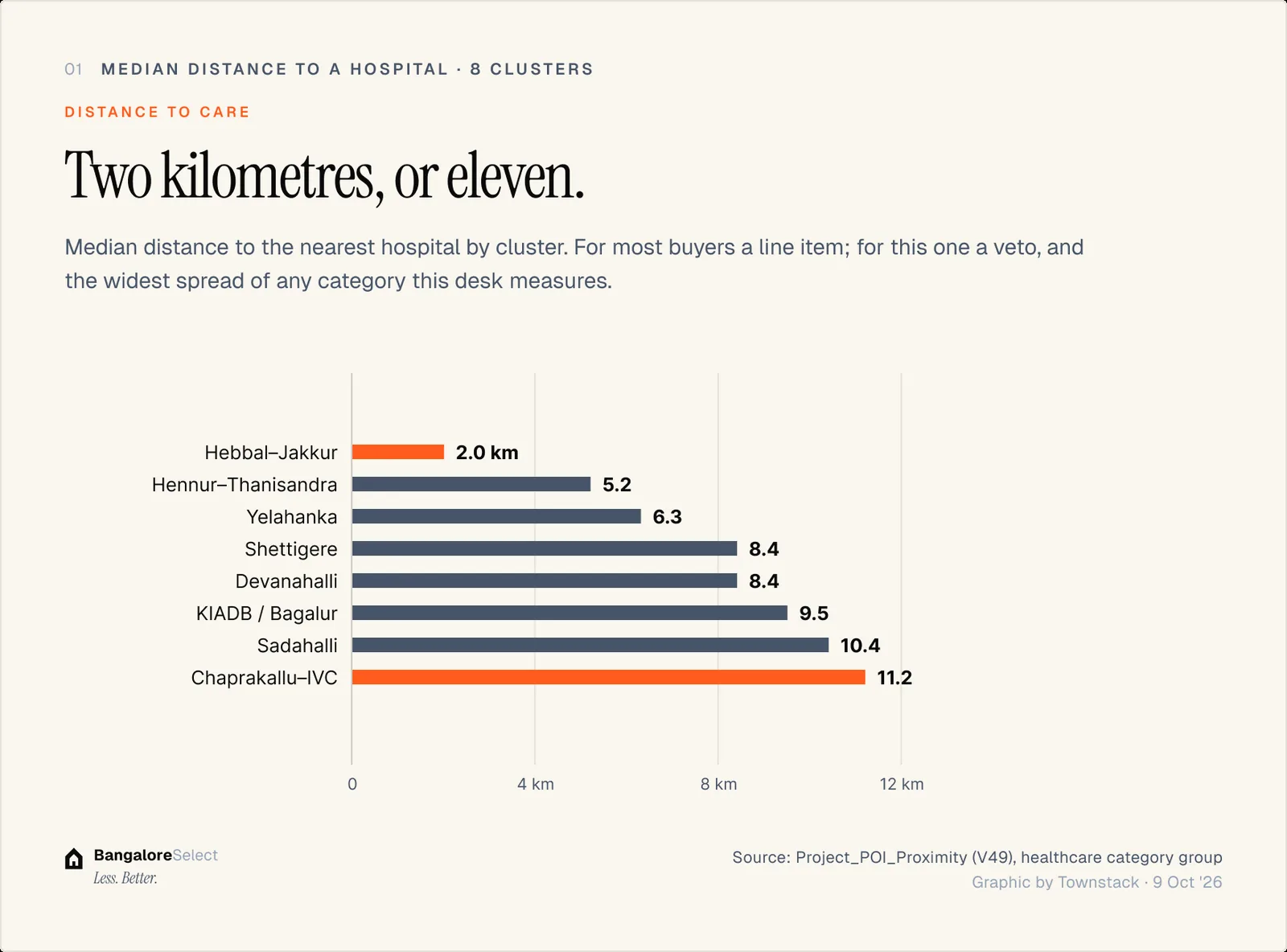
Across the eight tracked clusters, median distance to the nearest hospital runs from 2.0 kilometres at Hebbal–Jakkur to 11.2 at Chaprakallu–IVC. That 5.5-fold spread is the widest of any category we measure, wider than education, metro or retail.
Who this is
Selling a larger family home, often one the children have left, and buying something smaller and more manageable. Frequently the most financially comfortable buyer in this series and almost always the one given the least specific advice, because the market's default advice is written for a thirty-five year old.
The brochure language aimed at you tends toward serenity and landscaping. The variables that will actually matter over the next twenty years are medical proximity, whether the home works without stairs, and what happens in the building when the power goes.
The distance that is a veto
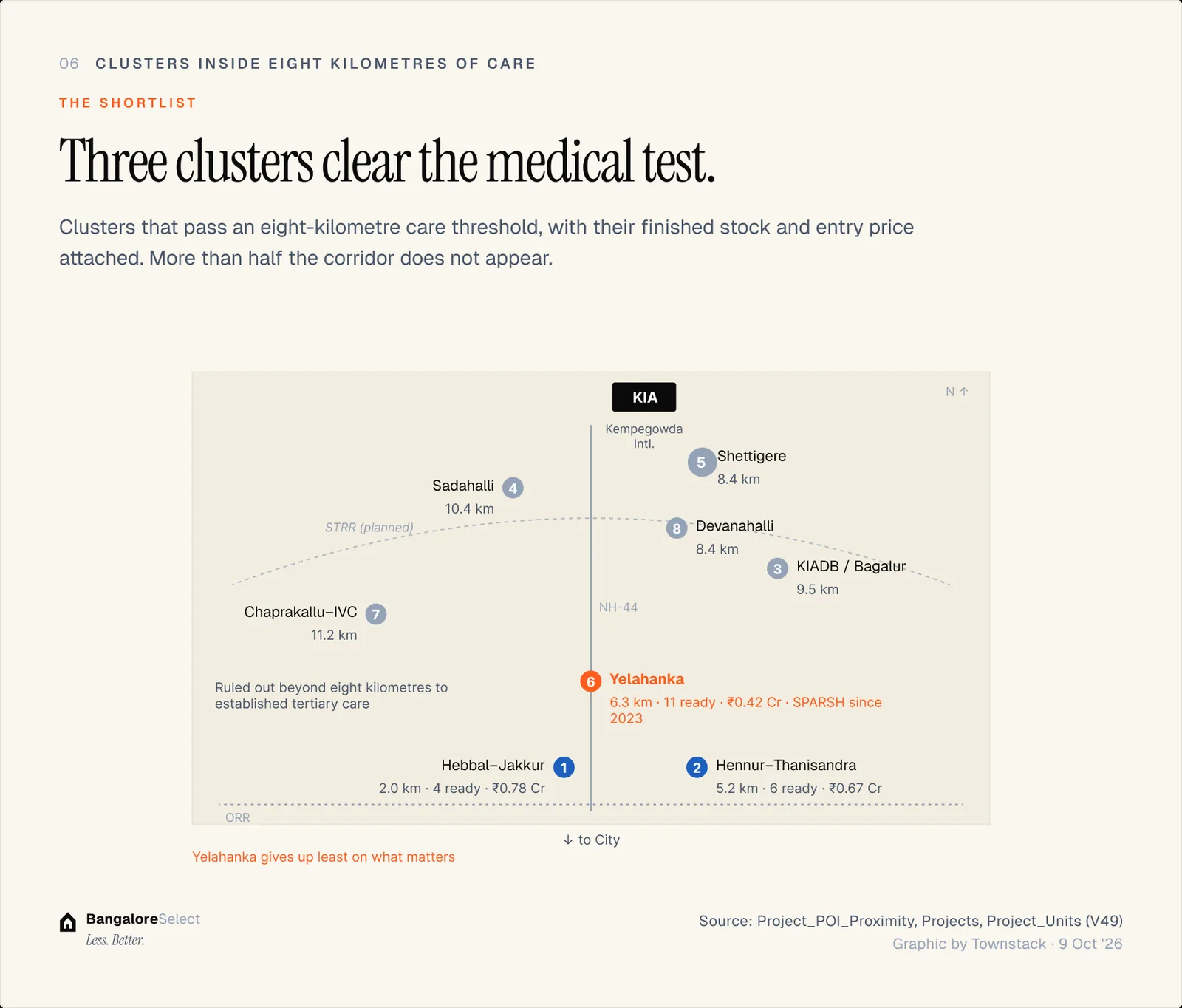
Median hospital distance by cluster: Hebbal–Jakkur 2.0 km, Hennur–Thanisandra 5.2, Yelahanka 6.3, Shettigere 8.4, Devanahalli 8.4, KIADB–Bagalur 9.5, Sadahalli 10.4, Chaprakallu–IVC 11.2.
Put the corridor's best and worst side by side. Two kilometres is a journey you make without thinking. Eleven, on roads that include a toll plaza and an airport approach, is a journey you plan. At three in the morning, in the rain, with somebody in the back seat, those are not two points on the same scale.
This is also the one measure where the corridor's cheapest clusters are not quietly good value. They are structurally thin on the thing you most need, and the discount is partly for that.
The constraint that actually filters
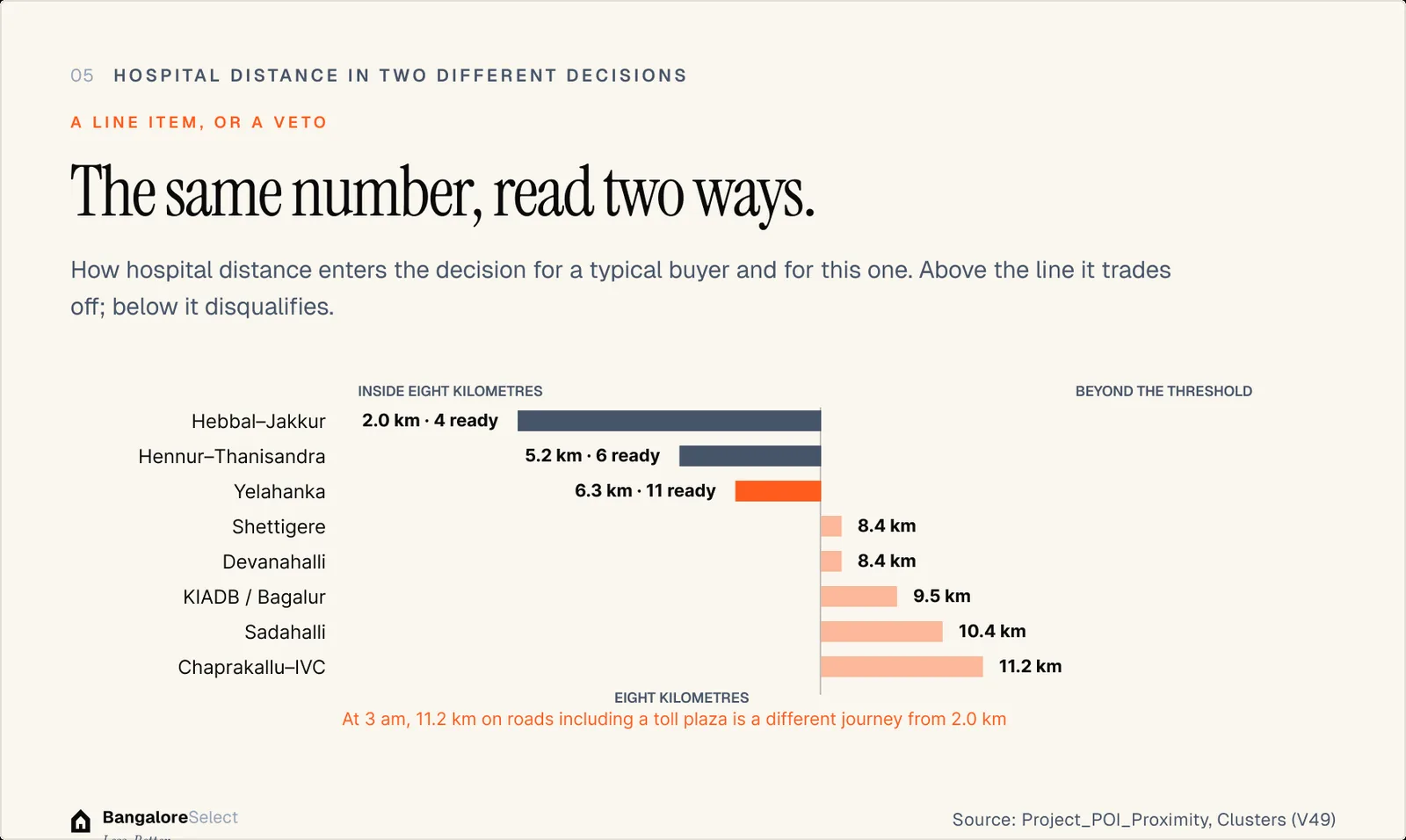
Tertiary care within a short, predictable drive, plus a home that does not depend on your own mobility holding.
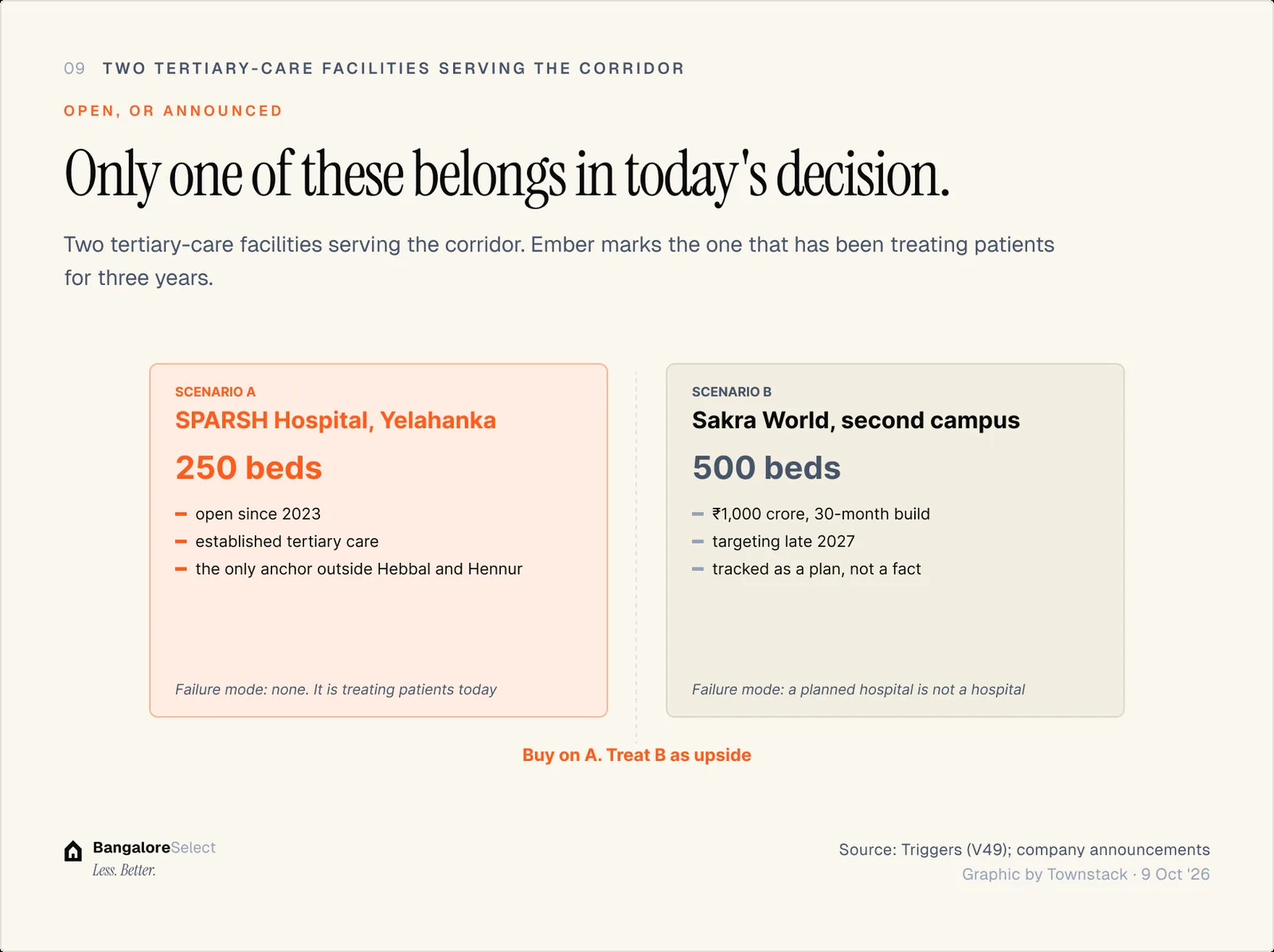
On the first, Yelahanka is the corridor's strongest honest answer. SPARSH has run 250 beds there since 2023, which makes it the only cluster outside the Hebbal and Hennur belt with established tertiary care rather than planned. Sakra's second campus, 500 beds at ₹1,000 crore, is a 2027 target and should be treated as a plan rather than a fact until it opens.
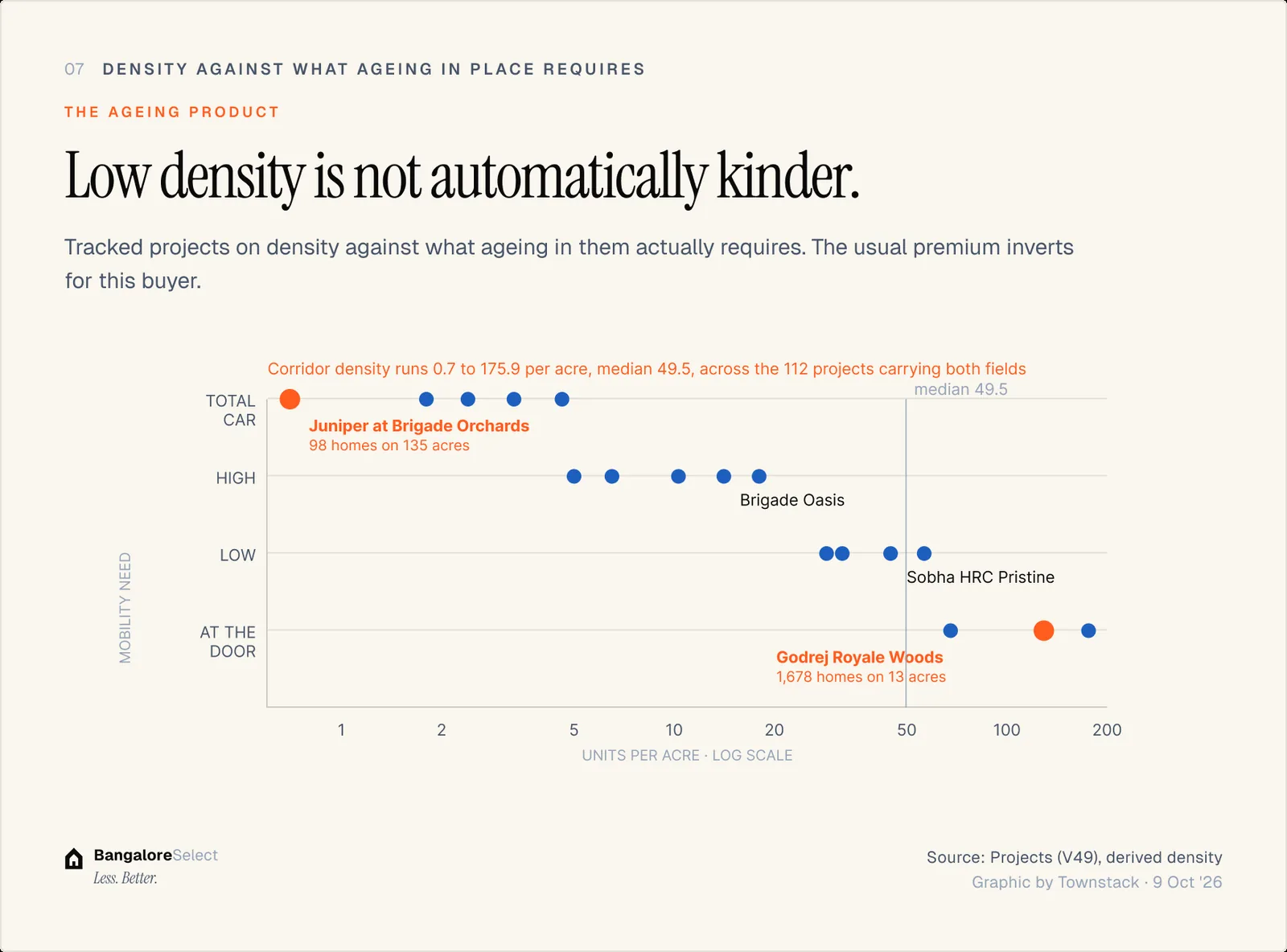
On the second, density cuts both ways and the direction is not obvious. A very low-density villa development means stairs, distance to the gate, and total dependence on a car. A mid-rise with lifts, a single-level flat and services at the door is frequently the better ageing product, which inverts the usual premium.
What survives the filter
Hebbal–Jakkur and Hennur–Thanisandra pass the medical test most comfortably, at 2.0 and 5.2 kilometres, and both carry finished stock: four ready projects in Hebbal and six in Hennur. The cost is the corridor's highest entry, ₹0.78 and ₹0.67 crore respectively, though as a downsizer selling a larger home you are among the few buyers for whom that is not binding.
Yelahanka is the value answer and a genuine one: 6.3 kilometres to a hospital, SPARSH established, eleven ready-to-move projects, entry from ₹0.42 crore, and a functioning town with a high street you can walk. For a buyer who wants to release capital from the sale rather than spend it, this is the cluster that gives up the least on the measure that matters.
Finished stock matters for you more than for most. You can visit on a weekday, ride the lift, see the ramp, check whether the paths are level and whether the generator actually runs.
One more thing to expect, because it surprises people at this stage of life: the compact, low-floor, lift-adjacent stock you want is the same stock investors want, and it is the most contested tier on the corridor. Our phase sheet records sub-₹9,000 releases clearing in two and three days, allotted in pre-launch rather than sold at launch. Competing for that in a queue you cannot see is a poor use of your time. Finished buildings let you walk the lift lobby, time the ramp, ask a resident about the water, and buy the specific floor you need rather than the one left over.
The twenty-year view of a staircase
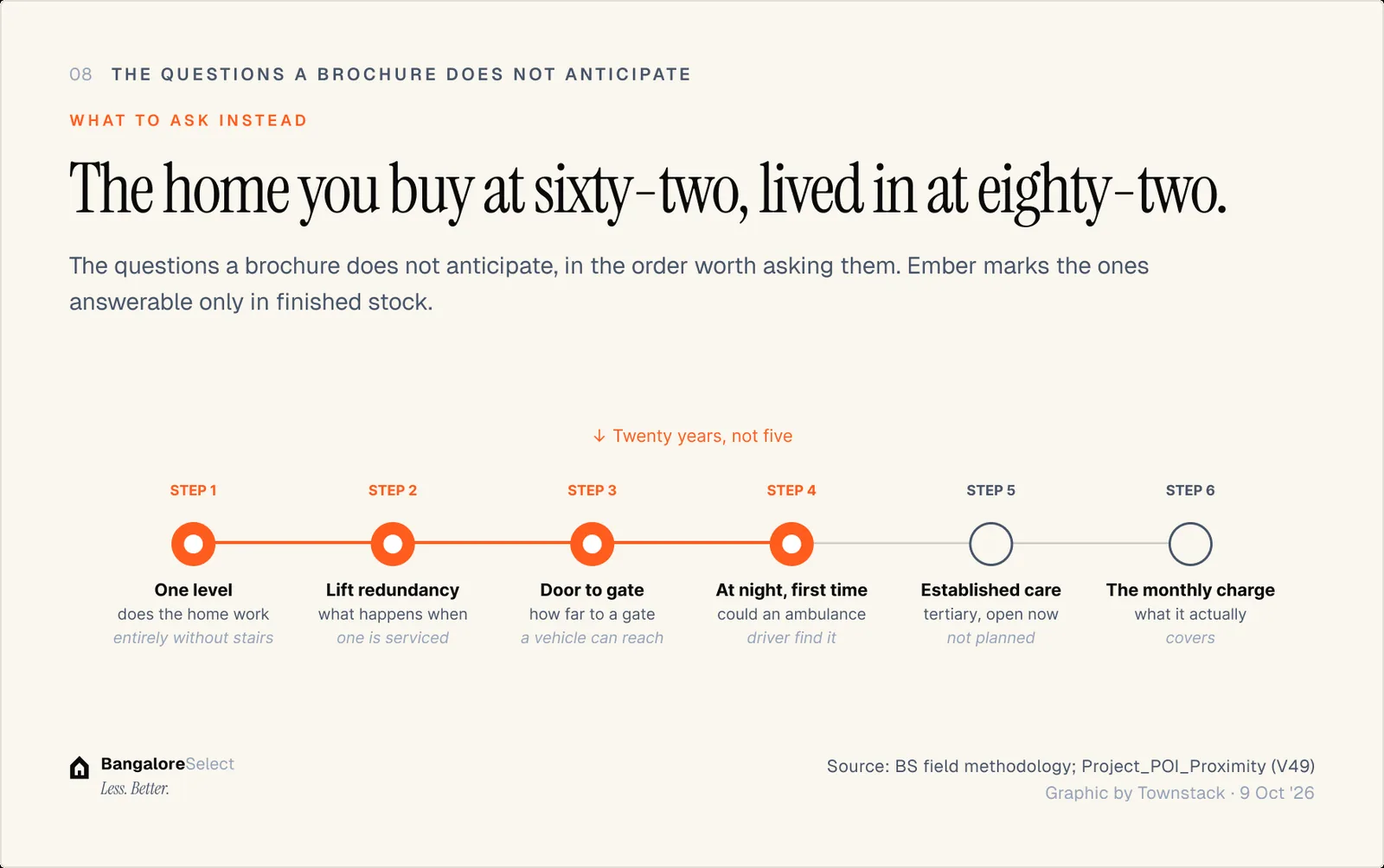
The home you buy at sixty-two is the home you are living in at eighty-two, and it is remarkable how rarely that sentence appears in a sales conversation.
A duplex with an internal staircase is a fine home for fifteen of those twenty years and a problem for the last five. A villa at two units per acre is beautifully quiet and a long walk from a gate an ambulance has to find. A fourth-floor flat in a building with one lift is fine until the lift is being serviced.
None of these are reasons not to buy. They are reasons to ask a different set of questions than the ones the brochure anticipates, and to ask them now rather than discovering the answers later.
What to refuse
Refuse any cluster beyond about eight kilometres from established tertiary care, regardless of what it costs or how good the project is. On this corridor that is a real constraint and it rules out more than half the map.
Refuse a planned hospital as though it were an existing one. Sakra's 500-bed second campus targets late 2027 and this desk tracks it as a plan. SPARSH's 250 beds at Yelahanka have been open since 2023. Only one of those belongs in your decision today.
And refuse the assumption that lower density is automatically better for you. Ask instead whether the home works on one level, whether there is lift redundancy, how far the gate is from the front door, and whether an ambulance driver who has never been there before could find it at night.
Sources. BangaloreSelect Tracked Dataset (BS_AutoResearch V49, sealed 2026-09-27). Median hospital distances by cluster: Project_POI_Proximity, healthcare category group. Ready-to-move counts and entry tickets: Projects, Project_Units. SPARSH Hospital Yelahanka and Sakra second campus: company announcements.
Want our next North Bangalore report in your Google results? Add BangaloreSelect as a preferred source and new reports show up in your Top Stories.