You Cannot Let a Promise: Yield, and the Stock That Can Actually Carry a Tenant
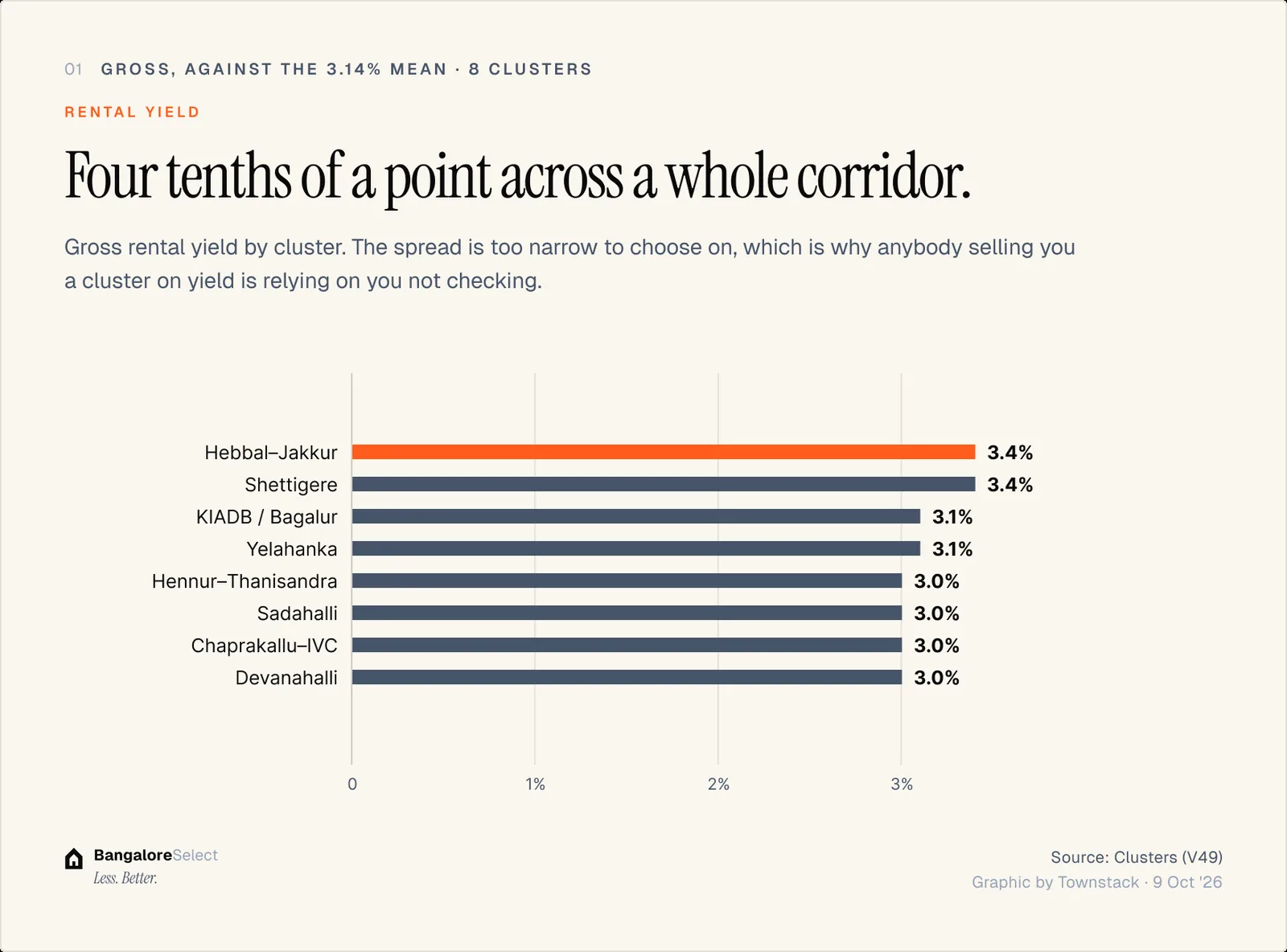
Rental yield across the eight tracked clusters runs from 3.0 to 3.4 percent. That is a spread of four tenths of a percentage point across an entire corridor, which means yield alone cannot tell you where to buy and anybody using it to sell you something is relying on you not noticing how flat it is.

Rental yield across the eight tracked clusters runs from 3.0 to 3.4 percent. That is a spread of four tenths of a percentage point across an entire corridor, which means yield alone cannot tell you where to buy and anybody using it to sell you something is relying on you not noticing how flat it is.
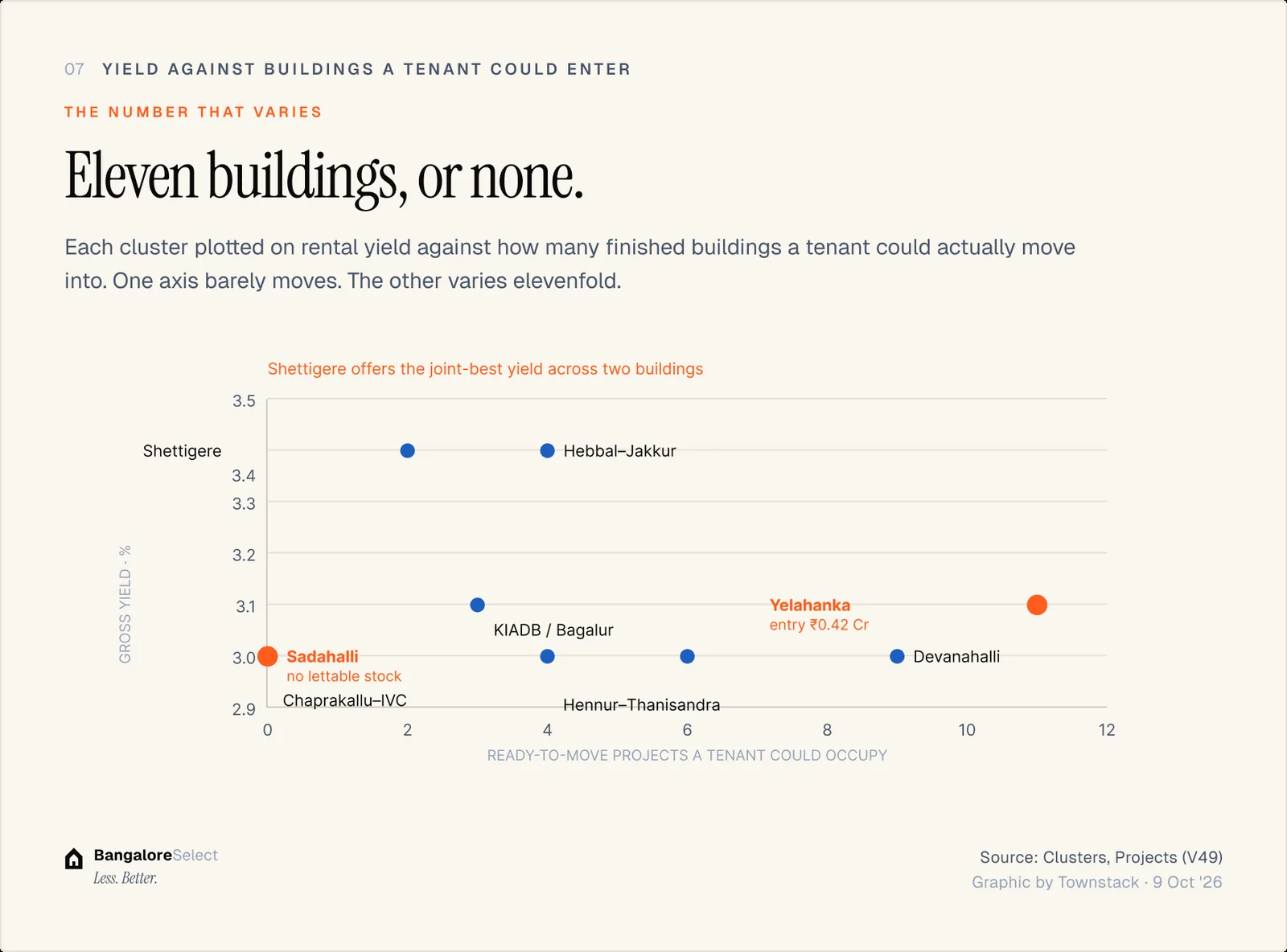
The number that does vary, by a factor of eleven, is how many buildings in each cluster a tenant could actually move into this month.
Yelahanka has eleven. Sadahalli has none.
Who this is
Buying to let, either as a standalone investment or as a hedge while you live elsewhere. Your return has two components and the market only ever discusses one of them.
Capital appreciation gets all the attention because it makes better copy. But a letting investment that sits empty for four years while a tower completes has a negative carry that no appreciation rate on this corridor repairs quickly, and the carry starts the month you take the loan.
The two numbers, side by side
Yield and lettable-today stock, by cluster. Hebbal–Jakkur 3.4 percent with four finished projects. Shettigere 3.4 percent with two. KIADB–Bagalur 3.1 percent with three. Yelahanka 3.1 percent with eleven. Hennur–Thanisandra 3.0 percent with six. Chaprakallu–IVC 3.0 percent with four. Devanahalli 3.0 percent with nine. Sadahalli 3.0 percent with zero.
Shettigere offers the joint-best yield on the corridor across two buildings. Yelahanka offers three tenths less across eleven. For a landlord those are not close, because the second number determines whether you can execute at all and the first determines only what you earn once you have.
The constraint that actually filters
A tenant who exists now, with an income that is already being paid in this postcode.
That is a stricter test than it sounds and it rules out most of the corridor's marketing. A cluster whose employment story is Foxconn at build-out, or Airport City's business park topping out, is describing tenants who arrive in 2029. Your mortgage does not wait for them.
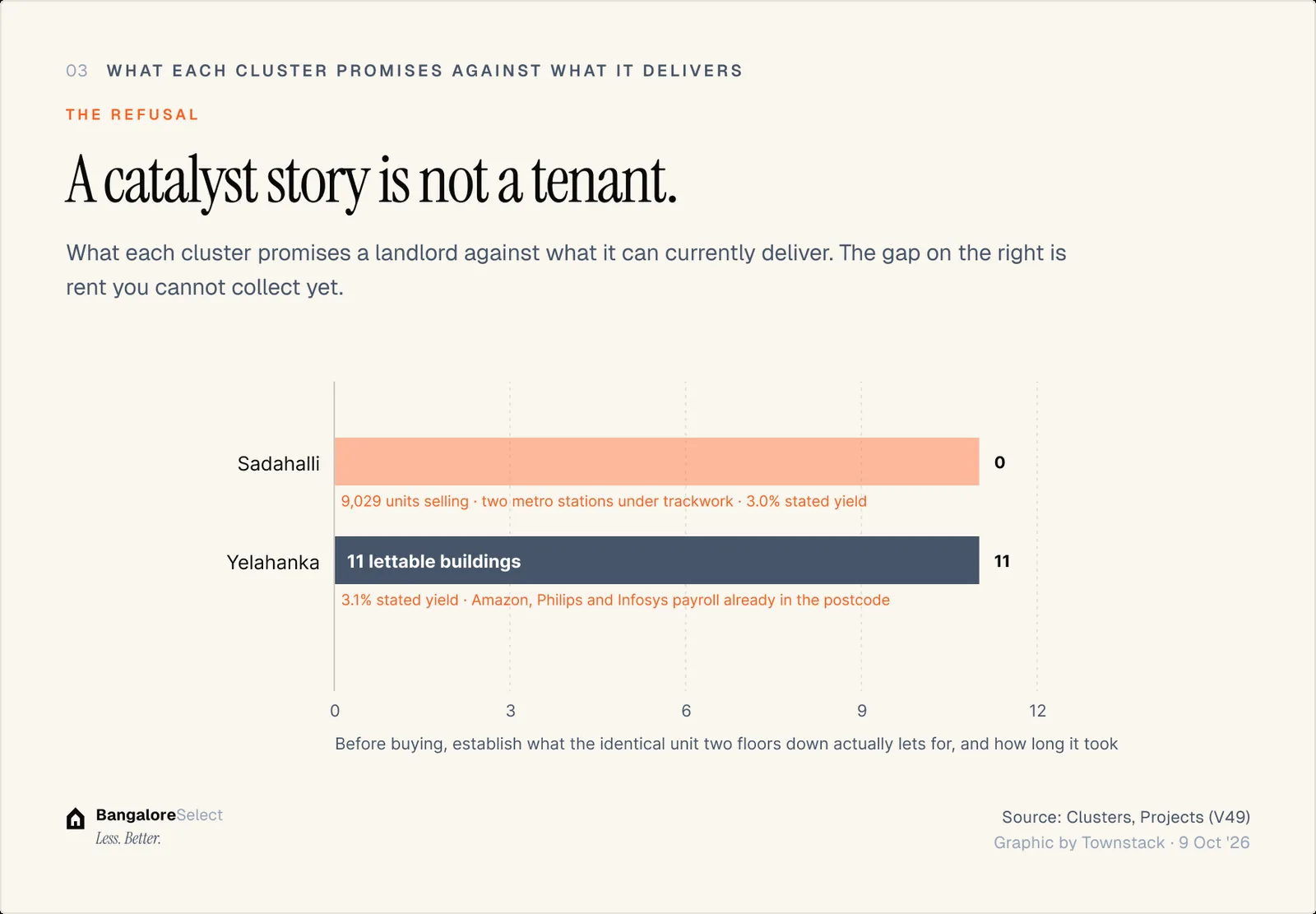
Yelahanka passes this test most clearly, and not because of the metro. Amazon's India headquarters runs 7,000 people at Sattva Horizon today. Philips holds 5,000 on Airport Road, Infosys Northgate another 5,000. Those salaries are being paid this month, into a cluster with eleven buildings where a lease could start in March.

What survives the filter
On a strict reading, the corridor's lettable universe is Yelahanka's eleven, Devanahalli's nine and Hennur's six, which is 26 of 39 finished projects and about two-thirds of everything a landlord can actually transact.
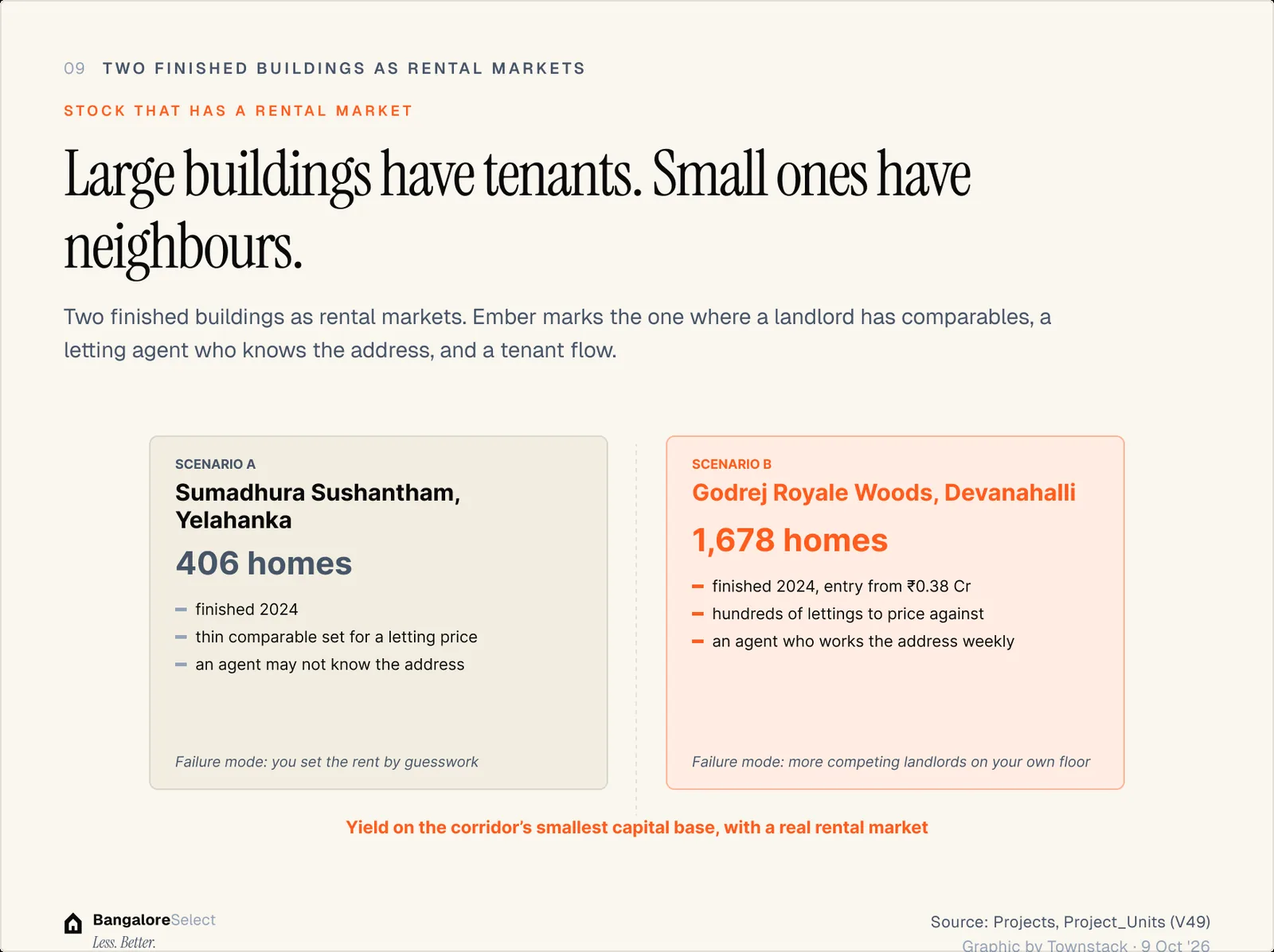
Named stock with scale, which matters because large buildings have functioning rental markets and small ones do not: Godrej Royale Woods at Devanahalli, 1,678 homes. Brigade Oasis, also Devanahalli, 987. Purva Atmosphere at Hennur, 939. Nikoo Homes IV at Hennur, 716. Godrej Aqua at Bagalur, 540. Sumadhura Sushantham at Yelahanka, 406.
Entry pricing helps too. Yelahanka opens at ₹0.42 crore and Devanahalli at ₹0.38, so the yield you earn sits on the corridor's smallest capital base, which is the arithmetic that actually drives a letting return.
The awkward part of the yield case is that the best yielding stock is the hardest to buy. Compact units are what a tenant wants and what every other investor has worked out, and our phase sheet records keenly priced releases clearing in two and three days, which means they were allotted in pre-launch rather than sold at launch. If you are not in the expression-of-interest book, you are buying this stock on resale at a resale price, and the yield has to be recalculated on what you actually pay rather than on the launch number in the brochure.
The four empty years
Run the comparison properly, because the brochure never will. Two identical ₹1 crore purchases. One is finished and lets from month one at 3.1 percent, roughly ₹3.1 lakh a year. The other completes in 2031 and lets at 3.4 percent from then.
By the time the second one houses its first tenant, the first has collected something close to ₹15 lakh and has been paying down principal with somebody else's money for four years. The 3.4 percent never catches the 3.1 percent, not because the rate is wrong but because the clock started at a different time.
This is the most under-priced variable in north Bengaluru residential investment and it is sitting in a column nobody reads.

What to refuse
Refuse an under-construction purchase justified by a higher future yield. On a four-year build the foregone rent exceeds the yield difference available anywhere on this corridor, and the difference between best and worst is four tenths of a point.
Refuse Sadahalli for a letting strategy, at least until something completes there. It has the corridor's strongest catalyst story and zero lettable buildings, and those two facts belong in different investment cases.
And refuse to let a yield percentage do the work of a tenant survey. Before you buy, find out what the identical unit two floors down is actually let for and how long it took to let. That is the only yield figure in this process that has a real tenant behind it.
Sources. BangaloreSelect Tracked Dataset (BS_AutoResearch V49, sealed 2026-09-27). Rental yield by cluster: Clusters. Ready-to-move counts and unit scale: Projects. Entry tickets: Project_Units. Employers: company announcements (Amazon, Philips, Infosys).
Want our next North Bangalore report in your Google results? Add BangaloreSelect as a preferred source and new reports show up in your Top Stories.