Two Premiums, Ten Years Apart: Hebbal–Jakkur vs Chaprakallu–IVC
In 2015, Hebbal was a flyover with potential: a junction where the city's money had begun to slow down and look around. A decade later it trades at ₹18,000 a square foot and its open question is not whether the premium holds but how much higher the built-out ceiling goes.
In 2015, Hebbal was a flyover with potential: a junction where the city's money had begun to slow down and look around. A decade later it trades at ₹18,000 a square foot and its open question is not whether the premium holds but how much higher the built-out ceiling goes.
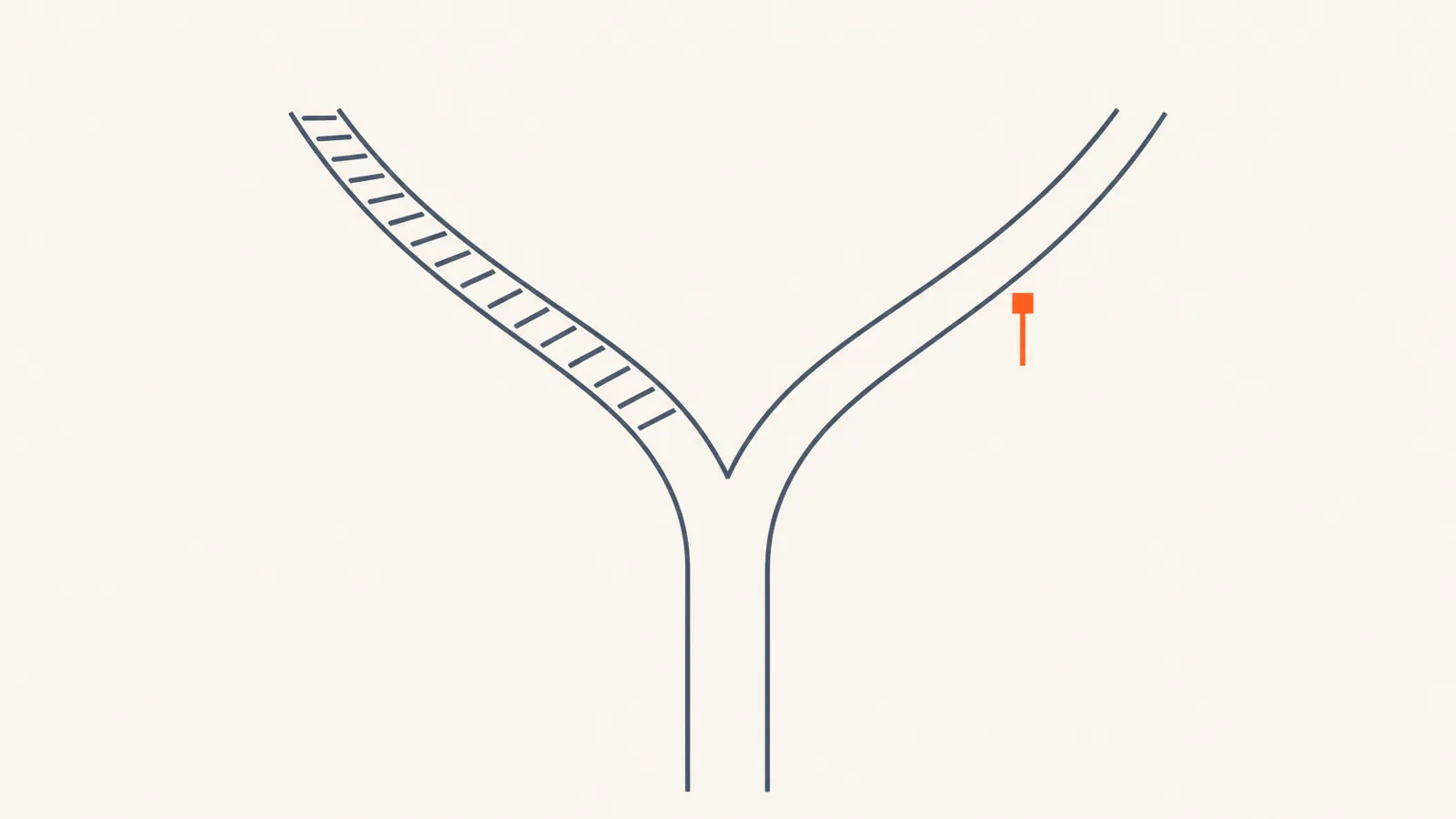
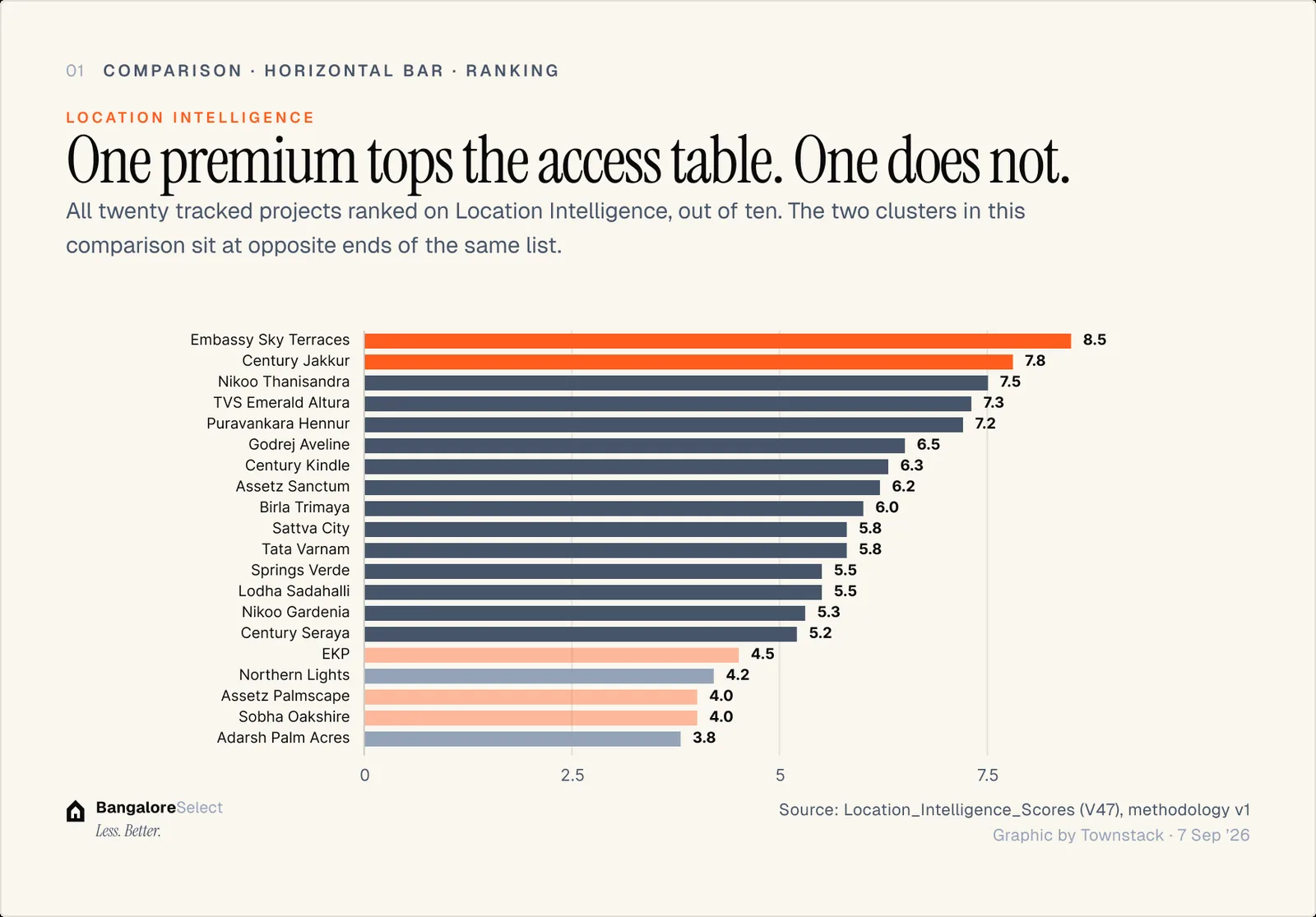
Chaprakallu–IVC today occupies the seat Hebbal occupied then: about ₹11,000 a square foot on the corrected land-led blend, a 77 percent three-year arc (the earlier 134 percent figure died with the ₹14,500 headline it was computed on), anchor institutions arriving in sequence, and a buyer base that has decided early. The comparison between them is really one question wearing two price tags: do you buy the premium that has finished forming, or the one that appears to be halfway through the same climb?
It is the most expensive decision in the dataset (these are its two costliest clusters) and the data says more about it than the brochures do.
The numbers, side by side
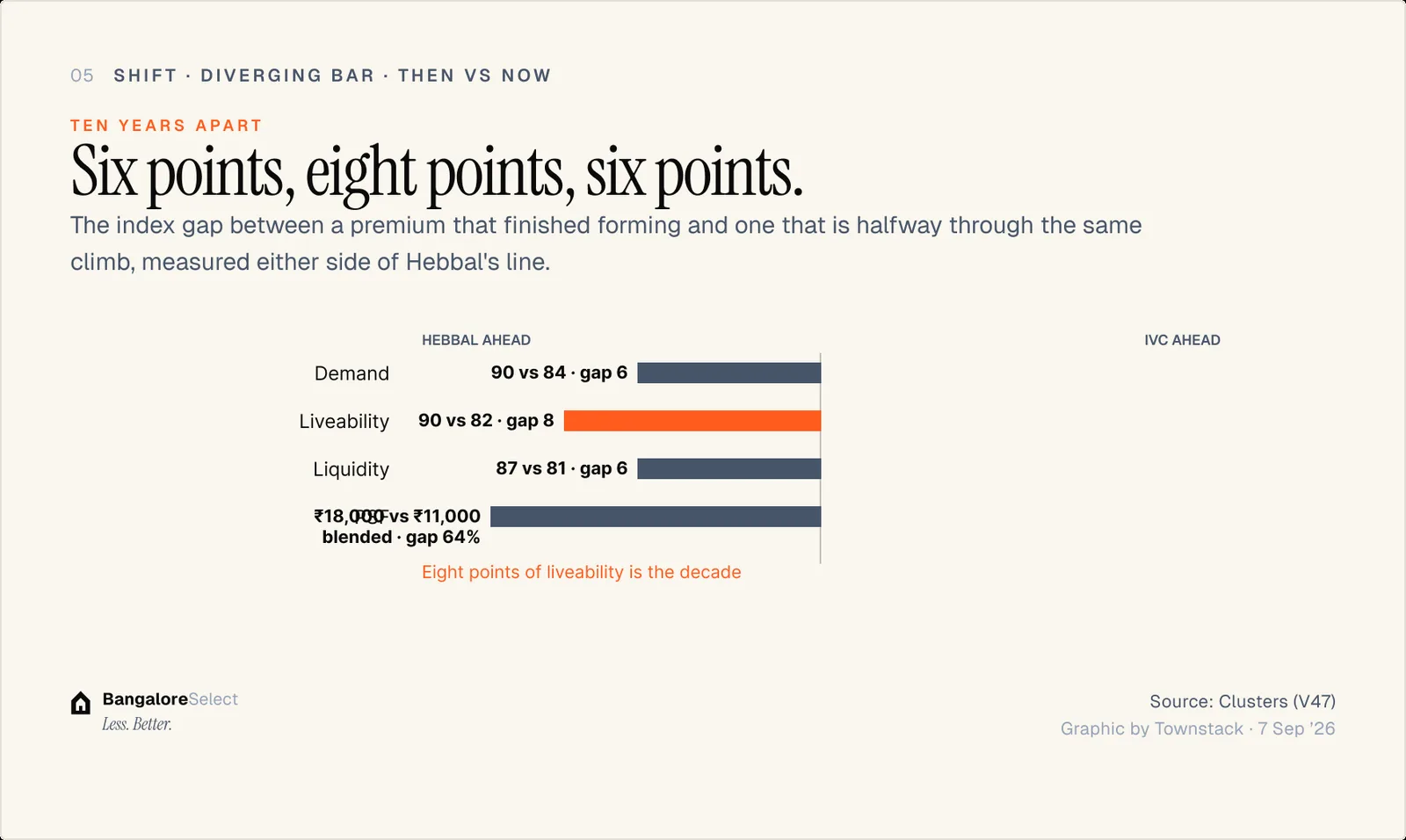
Hebbal–Jakkur: ₹18,000 per square foot, 8 percent tracked growth, three-year arc 71 percent, five-year 112. Demand 90, Liveability 90, Liquidity 87. Chaprakallu–IVC: about ₹11,000 blended, 11 percent tracked growth, three-year arc 77 percent and five-year 144 on the corrected blend. Demand 84, Liveability 82, Liquidity 81.
The gap in the indices (six points of demand, eight of liveability, six of liquidity) is the honest measurement of those ten years. Hebbal's numbers are what a corridor looks like after the hospitals, malls, offices, and flyovers have all opened. IVC's are what one looks like while the institutions are still cutting ribbons. The ₹7,000 difference (wider than it looked under the old headline) is the market's current estimate of how much ribbon remains, remembering that IVC's number prices land where Hebbal's prices towers.
What the analogy gets right
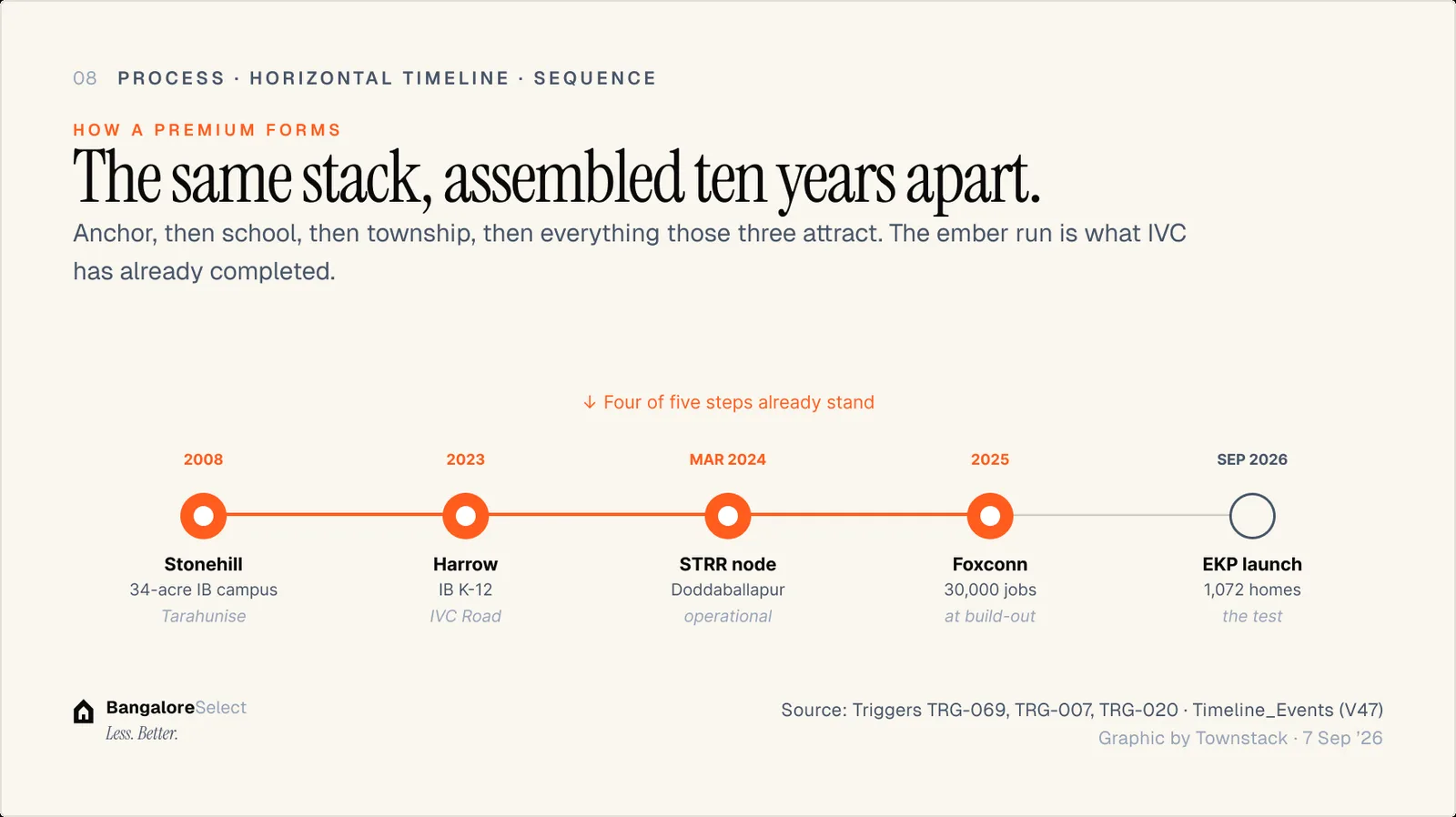
The Hebbal-in-2015 parallel is not lazy. Hebbal's climb was driven by a named employment anchor (Manyata), arterial position on NH-44, and institutional arrivals compounding one another. IVC is assembling the same stack from different parts: Foxconn's 30,000-job campus as the employment anchor, the airport trumpet and the STRR's Doddaballapur node as the arterial position, an education belt (Stonehill since 2008, Harrow since 2023, GITAM's university campus) as the institutional flags, and Embassy Knowledge Park (1,072 homes from ₹1.86 crore to ₹22.7 crore, K-RERA registered September 2026 as Embassy South Reserve and Embassy Riverine) as the developer commitment at scale.
Sequences like this are how premiums form. The market pays first for the anchor, then for the school, then for the township, then for everything the first three attract. IVC's 77 percent three-year arc on the corrected blend is that sequence being priced in real time, and the sequence is not finished.
What the analogy quietly skips
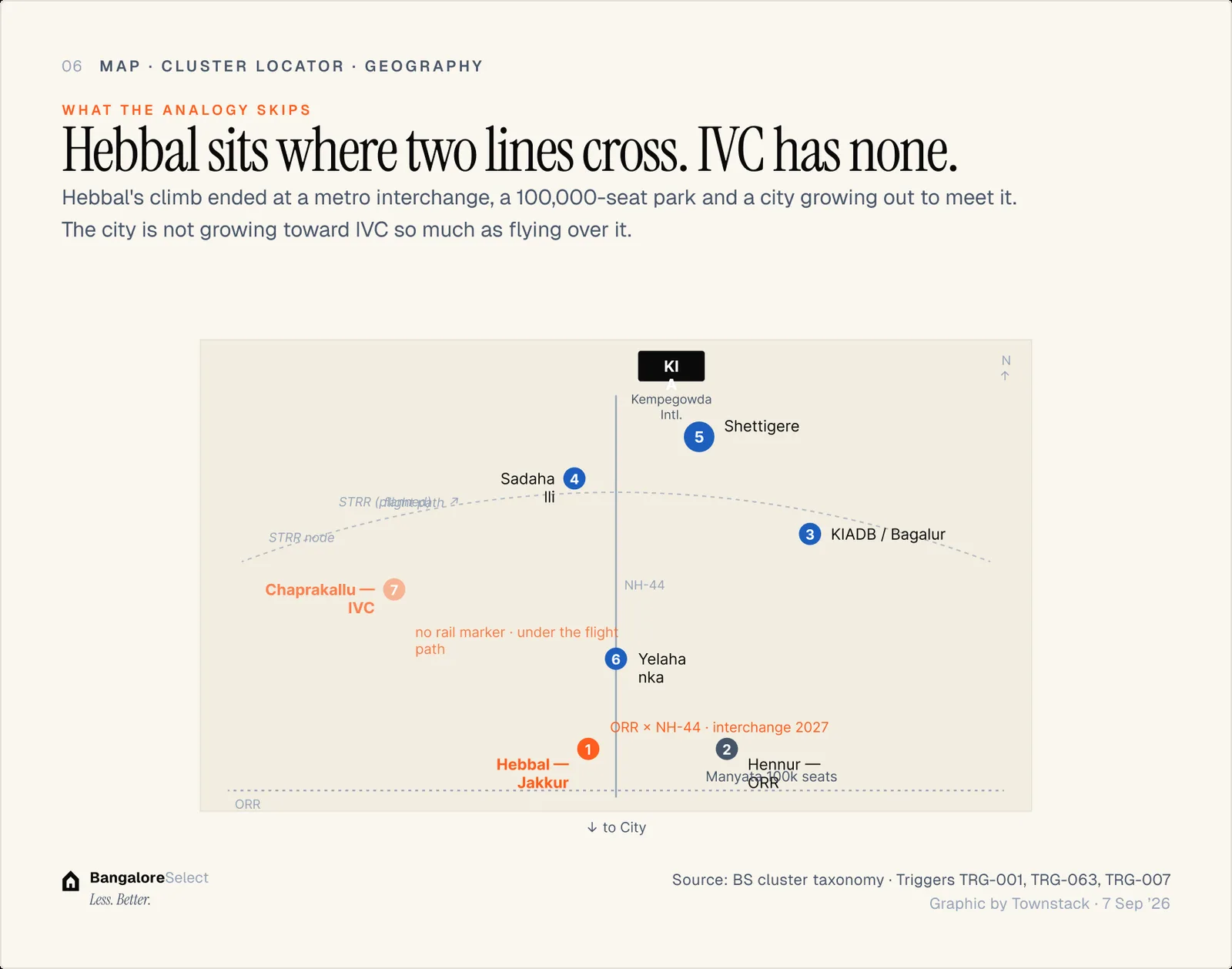
Hebbal's climb ended somewhere specific: at the intersection of two metro lines, a 100,000-seat tech park, and the city growing outward to meet it. IVC has no metro plan at all, its employment anchor builds phones rather than filling Grade-A offices with ₹40 lakh salaries, and the city is not growing toward it so much as flying over it, four lanes at a time, on the way to the terminal.
That doesn't break the thesis: the original cluster series established that IVC's premium is typology, not proximity, and typology premiums are durable. But it caps the analogy. Hebbal's ceiling kept rising because every kind of buyer eventually needed Hebbal. IVC's buyer pool is, by design, one kind: the household above ₹5 crore that wants low density and a British school run. A premium built on one buyer type rises fast and plateaus early. The question is where the plateau is, and nobody has seen it yet.
The arithmetic of catching up
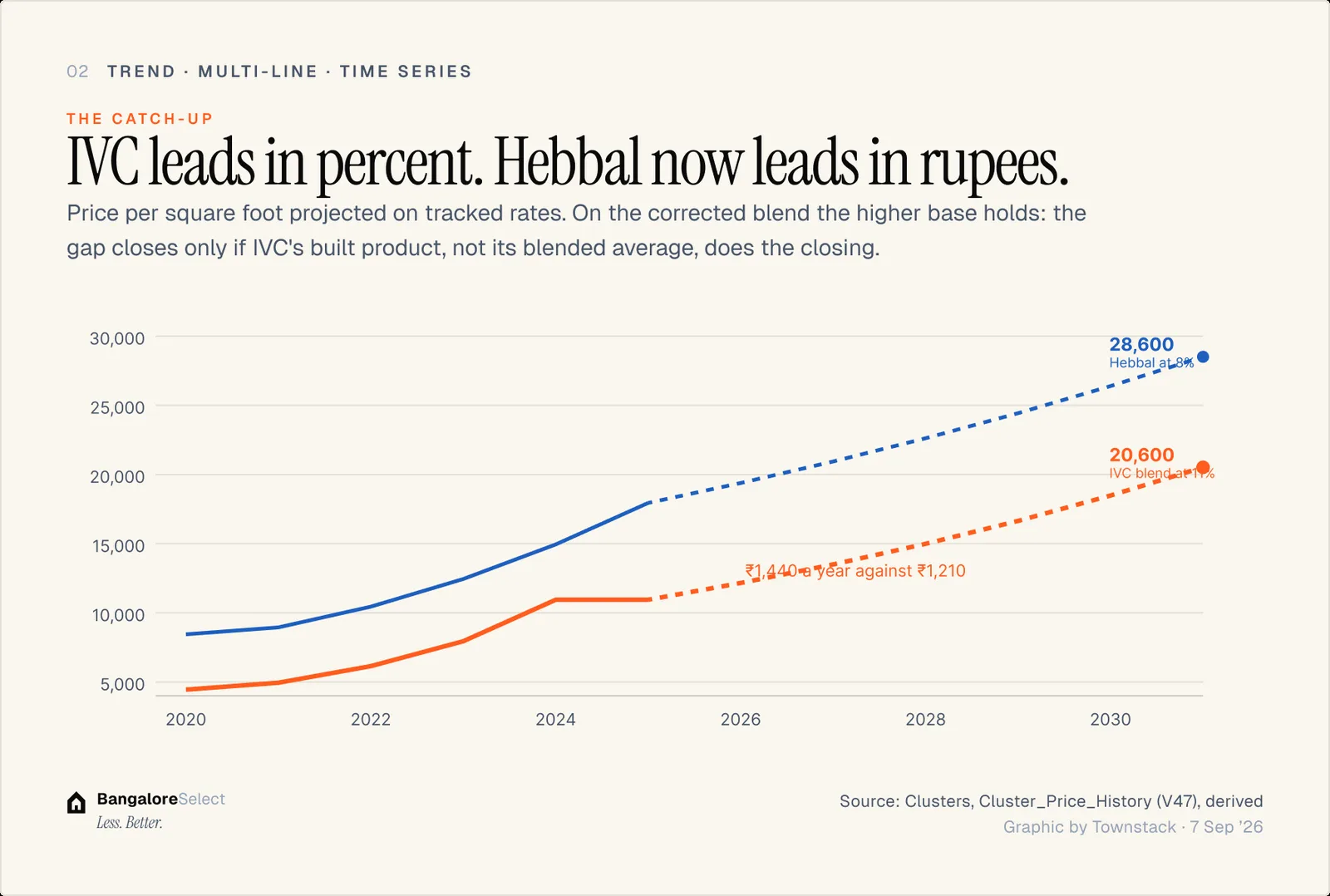
For IVC's blend to reach today's Hebbal price it needs about 64 percent of appreciation: four-to-five years at its current 11 percent, assuming Hebbal stands still, which it will not. And the comparison itself is partly an illusion: the blend prices plots and row houses, and there is no apartment psf here yet to converge with anything. The convergence trade, to the extent it exists, runs through Embassy Knowledge Park's apartments giving the corridor its first true apartment print.
The Hebbal side has its own arithmetic worth respecting: 954 units of total pipeline against IVC's growing book, a CBA-anchored office base, and a tunnel and interchange arriving 2027 onward. Run the rupees honestly and the higher base now wins both ways: 8 percent on ₹18,000 adds ₹1,440 a foot a year, while 11 percent on ₹11,000 adds ₹1,210. The percentage lead is IVC's; the absolute compounding is Hebbal's. Convergence, if it comes, is a story about IVC's built product, which clears ₹22,000 today, not about its blended average.
What each premium sounds like
Premiums have acoustics. Hebbal's is the continuous mid-frequency wash of a corridor at full operation: flyover traffic, airport taxis, the Manyata shuttle fleet, a market that never fully idles. You pay ₹18,000 partly for that sound, because it is the sound of liquidity: somewhere in that noise, at any hour, someone is buying or selling something like your flat.
IVC's premium sounds like almost nothing. A departure climbing out of KIAL every few minutes, sprinklers on a golf course under construction, the Harrow bell carrying further than it should because there is so little to stop it. That silence is also a price: it is what the blend's built-product ceiling buys, and what the cluster's owners are betting the next decade of wealthy households will pay steadily more for. One premium is priced off noise, the other off its absence. The decade decides which appreciates faster; the buyer only decides which they can live inside.
The verdict
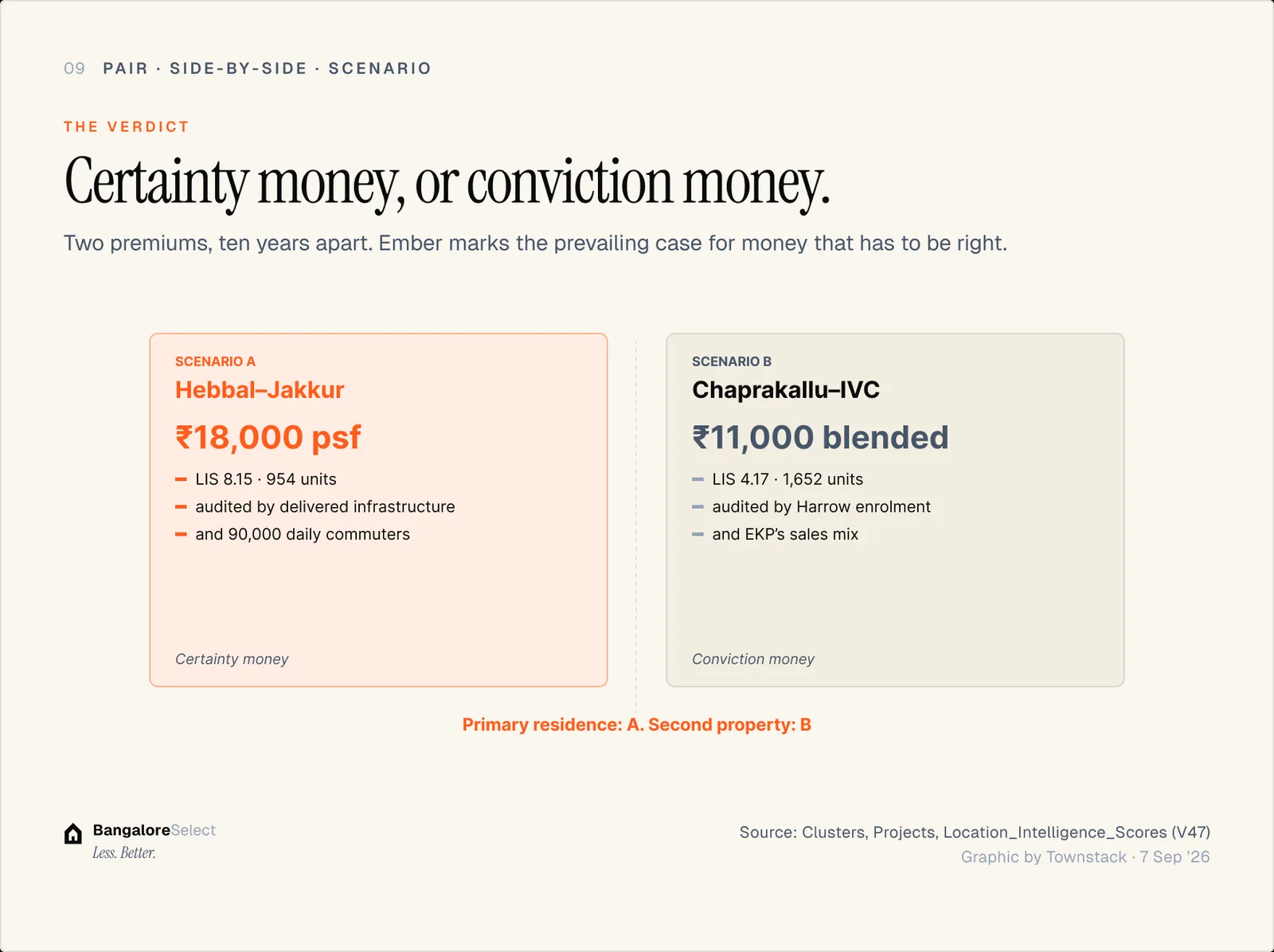
If the money you are placing is money you will need to be right (a primary residence, a single large allocation) buy Hebbal–Jakkur. Its premium is audited annually by ninety thousand commuters and a decade of delivered infrastructure, and its absolute appreciation per square foot still leads this pair.
If it is conviction money (a second property, a longer horizon, a tolerance for owning the plateau if it comes early), IVC, at a blended ₹11,000 whose built product already clears ₹22,000, is the only cluster in the dataset offering Hebbal's 2015 seat at any price. Take Embassy Knowledge Park's launch (its RERA number landed on 9 September 2026) as your entry marker and Harrow's enrolment growth as your ongoing audit.
And if you find yourself unable to choose, that is itself the answer: the buyer torn between these two wants Hebbal's certainty at IVC's price, and that product does not exist. It never does.
Sources. BangaloreSelect Tracked Dataset (BS_AutoResearch V47, 06-SEP-2026 working file). Embassy Manyata CBA built-to-suit: Embassy REIT investor disclosure. Embassy Knowledge Park launch: developer collateral, August 2026. Foxconn Doddagollahalli campus, Harrow International School IVC Road, Stonehill International School (Tarahunise), GITAM Bengaluru (Nagadenehalli): company, school and university records, 2008–2025.
Read more on the Hebbal–Jakkur cluster page and the Chaprakallu – IVC Road cluster page for the live project list, trigger feed and price-history chart referenced in this article.
Want our next North Bangalore report in your Google results? Add BangaloreSelect as a preferred source and new reports show up in your Top Stories.